
MCP Security: 200,000 Servers at Risk — What to Audit Before You Connect an AI Agent
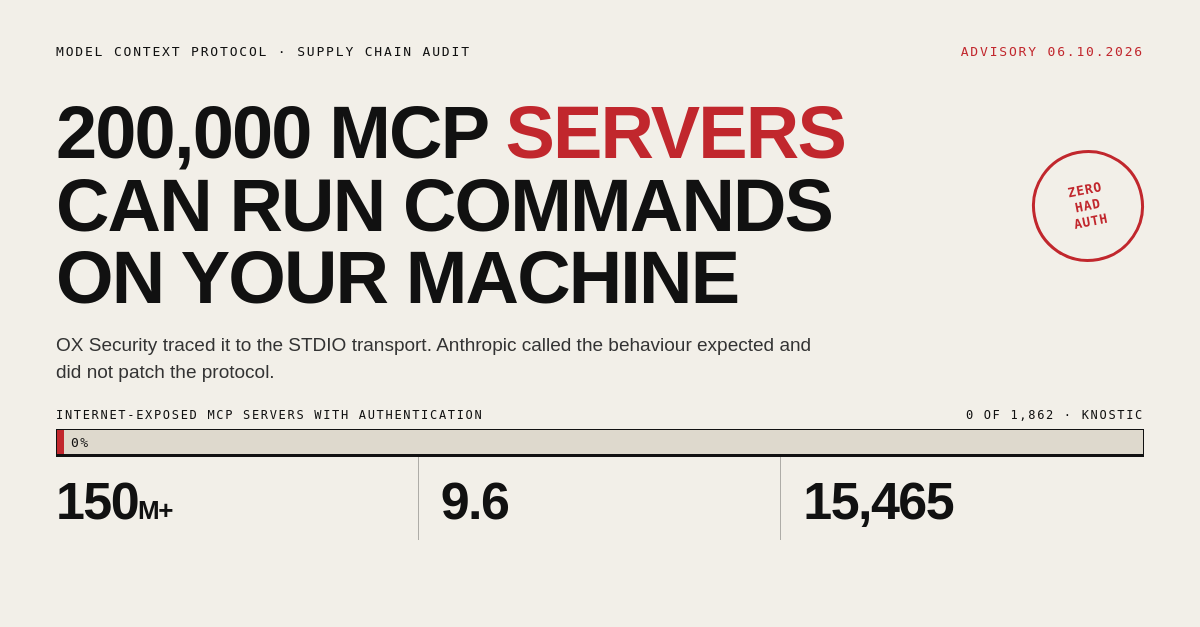
Security researchers say up to 200,000 MCP servers can be made to run commands on the machine that starts them, because the STDIO transport in Anthropic's Model Context Protocol spawns a server as a local subprocess and does not sanitize what comes back. Anthropic was told about it in April 2026 and declined to change the protocol, calling the behaviour expected. If your company connects AI agents to internal tools, the question worth answering this week is practical: which of your servers run over STDIO, whether they ask for a login at all, and whose instructions your agent is reading.
What the researchers actually found
OX Security published its research on 15 April 2026 under the headline "The Architectural Flaw at the Core of Anthropic's MCP". The mechanics are simple enough to explain in one sentence: when your AI client starts an MCP server over STDIO, that server is a child process on your machine, and whatever it sends back is treated as protocol traffic rather than as input that needs checking.
From there the blast radius is wide. OX Security puts it at more than 150 million package downloads, over 7,000 publicly accessible servers, and up to 200,000 vulnerable instances. They document four distinct families of exploitation, including unauthenticated UI injection in AI frameworks, zero-click prompt injection in AI IDEs such as Windsurf and Cursor, and malicious distribution through marketplaces. The team also reports more than 30 responsible disclosures and over 10 High/Critical CVEs while working through the ecosystem.
The bug is the smaller half of this. According to OX Security, they offered root patches to Anthropic that would have protected downstream users, and Anthropic declined to modify the protocol's architecture, citing the behaviour as "expected." The guidance that followed recommends using STDIO adapters with caution. A recommendation to be careful is not a fix, and it does not change how the transport works.
The specification says the quiet part out loud
This is not a case of the docs being unclear. The MCP authorization specification is explicit about where authentication applies:
"Implementations using an HTTP-based transport SHOULD conform to this specification. Implementations using an STDIO transport SHOULD NOT follow this specification, and instead retrieve credentials from the environment."
That sentence, taken from the MCP specification's authorization section, is still present in the current revision. OAuth 2.1 is the standard for remote servers, and it is a real improvement over what existed before. But it covers HTTP transports. Every local STDIO deployment falls outside it by design, and the installed base of agent stacks built before the OAuth work is still running the old rules.
Exposed servers are not an abstraction
Knostic's researchers scanned the open internet and found 1,862 MCP servers reachable from outside. They then manually verified a sample of 119 of them. All 119 let an unauthenticated caller list the internal tools available on the server. That is the reconnaissance step: an attacker gets a map of what your agent can do before making a single attempt to get in.
A production MCP server usually sits in front of things you care about — databases, internal APIs, chat logs, credentials. The tool listing is not harmless metadata.
OX Security's companion report, "15,465 MCP Servers. 0 Governance.", scans three public registries and finds a supply chain without consistent identity or access policy. Two numbers stand out: 15.6% of the 5,095 unique hostnames resolved to infrastructure outside the United States, including infrastructure in China and Russia, and 0.45% resolved to home networks or consumer tunneling tools. The protocol has no native mechanism for enforcing where connected tools run or where data is processed.
Separately, Practical DevSecOps counted more than 40 CVEs disclosed against MCP implementations between January and April 2026 alone, as reported by Startup Fortune on 6 October 2026. That count includes CVE-2025-6514, an OS command injection in the widely used mcp-remote library with a CVSS score of 9.6. We checked the download history: 437,323 downloads of mcp-remote between January 2024 and the disclosure date of 9 July 2025, per npm registry data, matching the figure JFrog reported in its advisory.
Tool poisoning is the attack that worries security teams
Tool poisoning hides instructions where the model will read them as trusted context: inside a tool's own description or parameter names. The agent has no reliable way to separate the legitimate documentation of a tool from an instruction planted next to it. In a multi-agent setup, one compromised MCP server can inject instructions that carry into every other server and agent trusting it in the same session, which means the surface grows with each integration you ship.
The awkward part is that this attack does not need your server to run a single shell command. It only needs your agent to read a description somebody else wrote.
This is why "we only installed three servers" is not the safety metric it sounds like. The metric is what those three servers are allowed to reach, and who wrote their descriptions.
What to audit before your team ships another agent
- Separate STDIO from HTTP deployments. List every MCP server your organisation runs. Mark which ones are spawned as local subprocesses and which are remote HTTP. Only the second group can use the OAuth 2.1 flow in the specification.
- Check for authentication on anything reachable from the internet. Knostic's 119 out of 119 result suggests the default assumption should be "there is none" until you have tested it. An unauthenticated tool listing is already a full capability map.
- Read the tool descriptions you did not write. Treat every description, parameter name and README from a third-party MCP server as untrusted content aimed at your agent, not at you.
- Pin versions and check provenance.
mcp-remotereached 4.7 million downloads in the last month alone. Popular does not mean reviewed, and the vulnerable window was measured in months. - Give agents the smallest surface that works. A server that can read a database does not also need write access, shell access, and your production credentials in the same process.
If you are buying this work in rather than doing it in-house, ask your provider which transport each server uses, how credentials are scoped, and what happens when a tool returns something unexpected. Vague answers to those three questions are a finding on their own.
Is MCP a bad idea?
No. Before MCP, every AI tool integration was a bespoke connector that someone had to write and maintain. The adoption across coding tools, agent platforms and thousands of community servers shows builders wanted this badly enough to ship it fast. Fast and unaudited is how you end up with a large exposed population and a vendor treating a hole in the floor as a design choice.
For a business, the practical position in October 2026 is narrower than "adopt" or "avoid": use MCP where it removes real integration cost, keep remote servers on authenticated HTTP, keep local servers off the network, and audit the descriptions your agent reads. The protocol is not going away. Whether your deployment gets fixed before someone else looks at it is a decision you still get to make.
How visible is your business to AI agents?
Agents decide which companies to mention before a human ever clicks. The free AI Izkaznica gives you an A–F grade in 5 seconds, no signup, plus what ChatGPT, Gemini and Perplexity currently say about you.
Get your free AI score →Planning an agent rollout? We build the integration and the guardrails together — see BoostSuite for the visibility side and get in touch for the MCP side.
Want to see how your site looks in AI search?
Free AI Izkaznica — enter a URL and see how ChatGPT, Gemini and Perplexity describe your business.
Get your free AI score →Frequently asked questions
What is the STDIO vulnerability in MCP?
MCP's STDIO transport starts an MCP server as a local subprocess of the AI client. OX Security's April 2026 research found that input from that subprocess is not sanitized, so a malicious or compromised server can run operating system commands on the host. The firm estimates up to 200,000 vulnerable instances across a supply chain of more than 150 million downloads.
Did Anthropic fix it?
Not the root cause, according to OX Security. The researchers say Anthropic declined to modify the protocol's architecture, describing the behaviour as "expected", and that the accompanying guidance recommends using STDIO adapters with caution. The STDIO exemption is still written into the specification's authorization section.
Does OAuth 2.1 in the MCP spec protect my servers?
Only if they use an HTTP transport. The specification states that HTTP-based transports SHOULD follow the OAuth 2.1 flow and STDIO implementations SHOULD NOT, retrieving credentials from the environment instead. Local STDIO servers are outside the authentication scheme by design.
How many MCP servers are exposed to the internet?
Knostic identified 1,862 servers reachable from the internet, and separately OX Security counted more than 7,000 publicly accessible servers as part of its April 2026 estimate. In Knostic's manual sample of 119, every one allowed unauthenticated tool listing.
What is tool poisoning?
Hiding instructions inside an MCP tool's own metadata, such as its description or parameter names, where the model reads them as trusted context. The agent cannot reliably tell legitimate documentation from an injected instruction, and in multi-agent sessions the injected instructions can spread to every agent that trusts the compromised server.
Sources: OX Security, 15 April 2026; Knostic, Mapping MCP Servers Across the Internet; MCP Specification, authorization section; NVD, CVE-2025-6514; npm registry download data for mcp-remote; Startup Fortune, 6 October 2026.