
Gemini Now Adds UTM Parameters to Its Links — What That Means for Your AI Traffic
Google Gemini started appending UTM parameters to its outgoing links around 1 October 2026, which means clicks from Gemini can finally be attributed to a source instead of landing in the "Direct" bucket of your analytics. Before the change, most Gemini visits on mobile passed no referrer at all, so GA4 and other tools had nothing to work with. ChatGPT links have carried UTM tags since June 2025. Gemini has now caught up, though Google has not documented exactly when the tags appear.
What actually happened
The change surfaced on Reddit in a thread titled "Google Gemini add UTM to results!" Search Engine Journal reported it on 1 October 2026, with John Mueller from Google replying in the same thread: "Nice. I see it too. Doesn't Gemini have a referrer too though? I thought you could already track them."
That question is where it gets interesting. A commenter called CrawlWarden explained why a referrer was never enough:
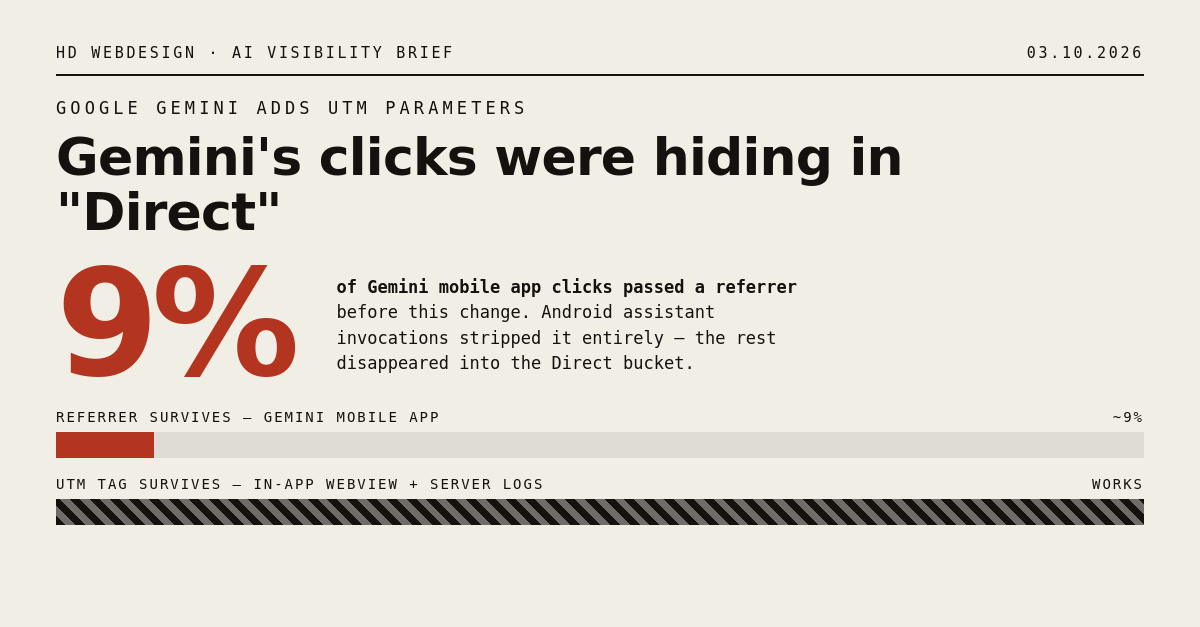
"There is a referrer, but it mostly survives on desktop web only, reported pass through from the Gemini mobile app runs around 9 percent and Android assistant invocations strip it entirely, so a large share of that traffic has been landing in Direct instead of GA4's ai assistant medium. A UTM survives the in app webview and shows up in raw server logs too, which is why this matters more than it looks even though the referrer technically already existed."
Mueller said he would forward reproducible referrer reports to the team and added that keeping referrers "in addition to the UTM tagging" would be ideal.
Why the referrer alone never worked
Analytics tools fall back to "Direct" when a visit arrives with no referrer and no UTM data. It is a default, not a measurement.
Three separate things were eating your Gemini data:
- Desktop web mostly worked. Referrers passed, sessions landed where you expected.
- The Gemini mobile app passed roughly 9% of referrer data through its in-app browser.
- Android assistant invocations stripped the referrer entirely.
So the channel with the fastest growth had the worst measurement. That is exactly the pattern that makes AI traffic look smaller than it is: the clicks you cannot attribute do not show up in the report you use to decide where to spend next quarter's budget.
A UTM parameter survives an in-app webview and appears in raw server logs even when your analytics platform never sees a referrer. That is the practical reason this is more than a footnote.
What changes in your reports
You get a source you can see. Sessions from tagged Gemini links carry campaign source information instead of defaulting to Direct. You can segment them, compare them against ChatGPT, Perplexity and Claude referrals, and compare them against organic search.
GA4 already has a bucket waiting for them. Since 13 May 2026, Google Analytics assigns medium = ai-assistant and files the session under the "AI Assistant" channel in the Default Channel Group, with the campaign dimension set to the reserved label (ai-assistant), as PPC Land documented on 14 May 2026. No configuration needed. The catch: that classification keys off the referrer. No referrer, no classification. UTM data covers the gap.
Server logs get the signal too. Anything reading your access logs can attribute the visit without waiting for a tag manager or an analytics SDK.
Comparison becomes honest. Before this, saying "AI search sends almost nothing" was partly an artifact of measurement. You can now separate real zero-click behaviour from lost attribution.
What ChatGPT already does
OpenAI added UTM parameters to ChatGPT's outgoing links in June 2025. One important limitation: ChatGPT tags links that appear in answers grounded on web sources, not answers drawn from model knowledge. So a link only gets tagged when the model is actually citing the web.
Gemini's implementation is undocumented as of this writing. Google has not published which parameters it appends, or in which answer formats they appear. The reasonable guess is a similar pattern — tags on links tied to cited sources — but "reasonable guess" is not documentation, and you should not build a report on it.
What to do this week
- Look for new
utm_sourcevalues in your analytics. Open GA4, filter sessions by source/medium over the last 7 days and look for anything you do not recognise. Do not assume a specific string — Google has not published one. If you find nothing, check your raw server logs, where the parameters show up regardless. - Check the AI Assistant channel. In GA4: Reports → Acquisition → Channels (Default Channel Group). If the channel is empty, that tells you something too — your traffic may still be sitting in Referral or Direct.
- Segment, then compare. Pull AI-referred sessions into their own segment and look at engagement rate, pages per session, and conversions against organic search. AI visitors tend to enter on deeper pages, mid-funnel, because they land on the specific answer to their question rather than a homepage.
- Treat measurement as the easy half. Attribution only pays off if there is something to attribute. Being the source an AI assistant links to is a content and structural problem — clear answers, real facts with dates and sources, schema markup, pages that address one specific situation with depth. The GEO checklist covers the structural side.
Is your business visible in AI answers at all?
Attribution only matters if there is traffic to attribute. See how ChatGPT, Gemini and Perplexity currently describe your business — free A–F grade in 5 seconds, no signup.
Check your AI visibility →Why a small business should care
AI referral volumes are still modest. ChatGPT accounted for roughly 0.21% of website traffic in February 2026 research, against Google's approximately 40%. But 23× conversion rates and mid-funnel entry points make that traffic worth more per visit than the share suggests. We covered the same shift from the demand side in why GEO has gone mainstream.
Until now, the honest answer to "is AI search sending us customers?" was "we cannot tell". That answer just got shorter.
Want to see how your site looks in AI search?
Free AI Izkaznica — enter a URL and see how ChatGPT, Gemini and Perplexity describe your business.
Get your free AI score →Frequently asked questions
Does Gemini add UTM parameters to all its links?
Google has not documented the behaviour. It was confirmed publicly by Google's John Mueller in a Reddit thread on 1 October 2026, but the trigger conditions — which answer formats produce tagged links — are not published yet.
Why did Gemini traffic show up as Direct in GA4?
Direct is the fallback when a visit arrives with neither a referrer nor UTM data. Gemini's mobile app passed referrer information for roughly 9% of traffic, and Android assistant invocations stripped it entirely.
What is the ai-assistant medium in Google Analytics?
A default channel classification Google added on 13 May 2026. When a referrer matches a recognised AI assistant, GA4 sets medium = ai-assistant, groups the session under the AI Assistant channel, and sets campaign to (ai-assistant). It requires no setup.
Does ChatGPT tag its links too?
Yes, since June 2025. ChatGPT adds UTM parameters to links in answers grounded on web sources, but not to links that would come from model knowledge.
How do I check whether my site receives AI traffic?
Filter your analytics by source/medium for AI platform names, check the AI Assistant channel, and inspect server logs for UTM parameters. Then measure how visible you are in the answers themselves with a free AI Izkaznica check.
Sources: Search Engine Journal, 1 October 2026; PPC Land, 14 May 2026; Google Analytics Help Center, Default Channel Group.