
Google's September 2026 spam update is complete. Here's what to check in Search Console
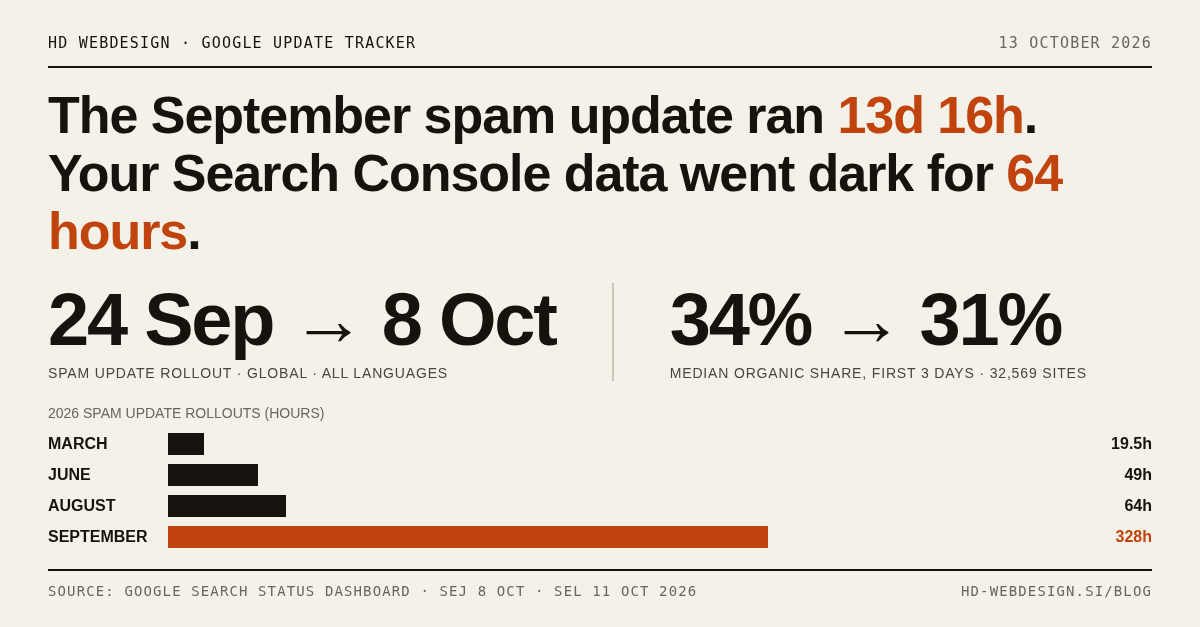
Google finished rolling out its September 2026 spam update on 8 October 2026 at 1:00 a.m. PDT, thirteen days and sixteen hours after it started. It ran globally, covered every language, and outlasted every other spam update Google has shipped this year by a wide margin. Then, while site owners were opening Search Console to see what happened, the performance report fell behind. On 11 October it was more than 64 hours stale. Both problems are now in the past, but if you look at your traffic chart from that window without knowing the timeline, you will read it wrong. Here is what actually happened, what the early data shows, and how to check your numbers this week.
When it ran and how it compared
Google announced the launch on 24 September 2026 and said from day one that the rollout "may take up to two weeks to complete." It used nearly all of that. The Google Search Status Dashboard records the update as finished on 8 October 2026, with the note "The rollout was complete as of October 8, 2026." Google's ranking update history puts the exact duration at 13 days and 16 hours.
For context, that is roughly fifteen times longer than the last update Google ran:
- March 2026 spam update: 19 hours and 30 minutes
- June 2026 spam update: 2 days and 1 hour
- August 2026 spam update: 2 days and 16 hours
- September 2026 spam update: 13 days and 16 hours
The reference point from last year is the August 2025 spam update, which ran from 26 August to 22 September 2025, about 27 days. So September 2026 is the longest rollout of this calendar year, but not a record overall.
One thing nobody can tell you yet: what the update targeted. Neither Google's spam updates documentation nor the dashboard notes describe what the September rollout addressed, or why it took so much longer than the three before it. As of publication, Google has not explained the gap.
What the early data shows
On 29 September, Diib published first numbers from 32,569 websites with connected Google Analytics. The comparison: each site's share of visits from unpaid Google search during 24–26 September against the same three days a week earlier. The median share fell from 34% to 31%. The share of sites that lost half or more of their organic traffic doubled, from 5% in the earlier period to 10%.
Two caveats come from Diib itself. It used share rather than absolute traffic because overall traffic dropped across the whole week, and it called the findings "an early read, not a verdict." The data also cannot show which sites Google identified as spam. Take it as a weather report, not a diagnosis of your site.
The stranger story comes from rank trackers. SEOmonitor reported that many trackers in the industry showed sudden ranking shifts starting 26 September, shifts that people searching on Google never saw. Its explanation: incomplete and incorrect results returned by Google during automated searches. In other words, your tracking tool may have recorded movement that did not happen for real users. This is the first update where that gap was wide enough to matter, and it is worth remembering the next time a dashboard shows a cliff.
Why Search Console went quiet
Normally this section would not exist. Google Search Console's performance report updates within a few hours, and page indexing is the part that lags. Between roughly 8 and 11 October, that relationship flipped: on Sunday 11 October at 7:15 a.m. ET, Barry Schwartz reported the performance report more than 64 hours delayed, calling it "incredibly unusual."
The timeline of the delay itself:
- 11 October, 7:15 a.m. ET: performance report 64+ hours behind
- 11 October, 11:00 a.m. ET: down to 44 hours
- 12 October: back to normal
Google did not comment on the delay while it lasted. The last comparable incident was December 2025, when performance and page indexing both ran late, and Google took a while to confirm anything was wrong. Two pieces of context matter if you were staring at a gap in your charts. Third-party Google tracking tools had already been struggling to scrape data for weeks, because Google has been blocking scrapers harder. And a delayed report is not missing data: when it caught up on 12 October, the numbers were there, just late.
Some commentators read the delay as a sign that a core update was coming. Schwartz doubted that connection, while noting that most of the industry expects a core update soon anyway. There is no evidence the two are related.
How to read your numbers this week
The useful outcome of this whole episode is a clean comparison window. The rollout ran from 24 September to 8 October, so you have an exact before, during and after. A few rules for using it:
- Draw the boundaries first. Compare the week before 24 September against the week after 8 October, not random Tuesdays against each other.
- Confirm in Search Console before believing any third-party chart. If a decline shows up in impressions and clicks in Google's own report, it is real. If it only exists in a rank tracker, treat it as noise until it doesn't.
- Give it several days. Spam update effects usually hold and deepen over days. A one-day dip that bounces back was probably never the update.
- Remember the report was late. Any reading you took between 8 and 12 October was based on stale data, and week-over-week comparisons from that period may need redoing now that everything caught up.
- Separate share from volume. The first week of the update saw overall organic traffic fall for everyone, so a stable share can still mean fewer visitors, and vice versa.
If your site did drop and it holds across several days in impressions and clicks, then it carries weight, and the next step is the same one Google's documentation prescribes: review the spam policies against what your site actually does. Google's guidance is blunt about the timeline as well. Making revisions may improve your standing, but only if the automated systems "recognize compliance over a period of months." Fixes are not overnight, and neither are recoveries. For the broader picture of what is coming after the spam update, we covered Google's rewritten ranking guidance last week.
What this means if you run a smaller business
For most small business sites, the honest answer is: nothing to do. Spam updates go after scaled abuse, hacked pages, cloaking and link networks, not a bakery site with thin content. The two habits from this episode transfer to everything, though.
First, verify at the source. An entire corner of the SEO industry spent late September reacting to charts that Google itself later said were showing incomplete data. When a dashboard and Google's own report disagree, the report with the fixed dates wins. Second, notice what a few days of blind reporting actually costs you. If new business depends on one channel, a week when you cannot even see that channel working is a real business risk, not an analytics nuisance. Sites that get found through ChatGPT and Gemini as well as Google are less exposed when any single one of them stumbles. If you do not know how AI assistants currently describe your business, that is a two-minute check.
See how AI tools describe your business
Free AI Visibility Card: enter your URL and get an A–F score of how ChatGPT, Gemini and Perplexity see your company, in about five seconds.
Get your free AI score →Frequently asked questions
When did Google's September 2026 spam update start and finish?
It started on 24 September 2026 and finished on 8 October 2026 at 1:00 a.m. PDT, a total of 13 days and 16 hours. Google said at launch that the update applied globally and to all languages, and warned it could take up to two weeks.
Why was the Search Console performance report delayed in October 2026?
On 11 October 2026 the performance report was more than 64 hours behind, which is unusual for that report, normally updated within hours. It improved to 44 hours later the same day and returned to normal on 12 October. Google did not comment during the delay. The closest previous incident was December 2025.
How do I know if the spam update affected my site?
Compare your Search Console impressions and clicks for 24 September to 8 October against the weeks before and after. A drop that lasts several days in Google's own data carries weight; a sudden change that appears only in a third-party rank tracker does not, because trackers showed phantom movement starting 26 September that searchers never saw. Early industry data found the median organic share fell from 34% to 31%, with 10% of sites losing half or more.
How long does recovery from a spam update take?
Google's documentation says revisions may improve your standing if its automated systems "recognize compliance over a period of months." Review the spam policies, fix what applies, and expect the timeline to be measured in months rather than days.
Was the Search Console delay a sign of an upcoming core update?
Some people speculated it was, but there is no evidence for it and Barry Schwartz of Search Engine Roundtable publicly doubted the connection. A core update is widely expected in the near term regardless, based on Google's update cadence, not on the reporting delay.
Sources: Google Search Status Dashboard, incident record and ranking update history, 8 October 2026; Search Engine Journal, 24 September and 8 October 2026; Search Engine Roundtable, 11 October 2026; Diib early data, 29 September 2026; SEOmonitor, October 2026; Google Search Central documentation on spam updates and spam policies.