
Google's Next Ranking Update: What the Rewritten Guidance Already Tells Us
A core update is probably coming before the end of the year, and Google has spent the last two weeks rewriting the document that describes what it rewards. That combination is the whole story. Search Engine Journal flagged the pattern on 5 October 2026: Google habitually ships a core update ahead of the US holiday season, and this year it edited its helpful content guidance twice in the same week that a spam update was still rolling out. If you own a website, the useful question is not "when." It is "what exactly did they change, and does my site still match it."
The spam update looks like preparation
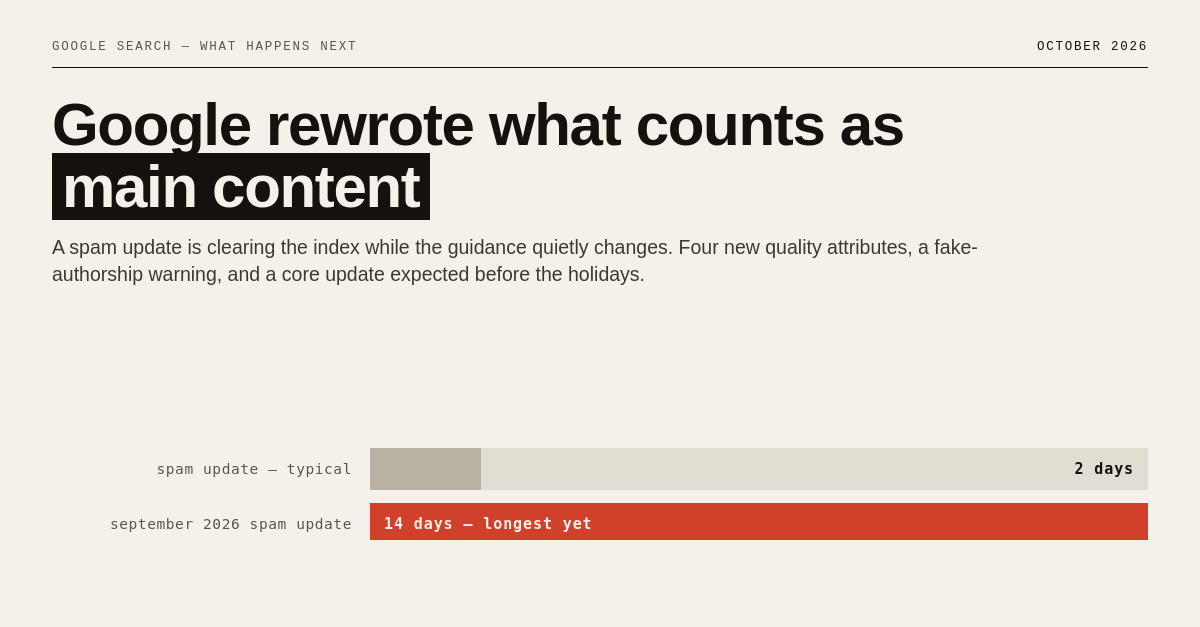
The September 2026 spam update started on 24 September and, by Google's own account, runs about two weeks instead of the usual two days. Search Engine Roundtable recorded three separate volatility spikes: 25 to 27 September, 30 September, and 4 to 6 October. Barry Schwartz's read on 6 October was that the third spike is probably the last one, meaning the rollout is finishing right now.
Search Engine Journal counts six updates since 2021 that were either preceded by a spam update or happened at the same time as one. The pattern suggests Google clears low-quality and manipulative content out of the index before it changes what the index rewards. An October 2023 spam update is the only outlier in that set.
That matters because a spam update removes things. A core update reorders things. Sites that got cleaned out in September will not be in the running when the next reordering happens, and sites that survived will be measured against guidance that did not exist in August.
What Google actually changed in the documentation
Two edits landed within days of each other. The first, covered by Search Engine Journal on 2 October, added a warning about fake authorship. The second, larger edit restructured how the guidance describes page quality. Search Engine Journal's 6 October write-up breaks it into a table; the substance is this.
The guidance now defines main content as whatever directly accomplishes the page purpose, and it names four attributes quality raters are asked to evaluate:
- Effort. How much human work and care went into the page. Mass generation with little curation is devalued.
- Originality. Whether the page offers perspective, data or testing that is not already sitting in the search results.
- Skill and experience. Whether the content shows the expertise the topic needs, or authentic lived experience where that is what fits.
- Accuracy. Strict factual accuracy, with an explicit caution about unreviewed AI hallucinations.
Google's own wording on the purpose test: high-quality content should "fulfill its purpose, satisfy users, and reflect meaningful effort, originality, skill, and accuracy." The accuracy line is blunt about generative models, noting that they predict a likely sequence of words rather than retrieve facts, and that every AI-assisted draft needs manual fact-checking before publishing.
"…one of the most critical factors for assessing page quality is the quality of the main content, specifically how effectively it allows the page to achieve its purpose and provide a satisfying user experience."
Read that once more and notice what is missing: word count, keyword density, publishing frequency. None of them appear.
Main content is not just your article text
This is the part most site owners will skip, and it is the part that changes what you should build. The guidance defines main content to include primary text and media (articles, images, audio, video), interactive features, user-generated contributions, expandable or tabbed content, and page titles and headings.
Interactive features get specific treatment. Google names calculators, online tools, games, and search functionality as forms of main content, on the condition that they help the page do its job. If your page exists to let people compare two things, the comparison tool on that page is main content, not decoration.
User-generated content counts too, but only when it serves the page: forum discussions, customer reviews, comments, uploaded media. A comment section that exists for its own sake is not an asset. A review that answers the question the page is asking is.
Titles and headings are treated the same way. The guidance describes them as elements that "summarize its topic and helps users make informed decisions about visiting." Not as keyword containers. Search Engine Journal's author makes the uncomfortable observation that exact-match keywords across every title and heading on a site could itself read as an unhelpful-content signal, because it is the fingerprint of a page built for a crawler rather than a reader.
Fake authorship is now an explicit quality signal
The new text on deceptive authorship does not hedge. Fabricating creator profiles with AI-generated headshots, made-up names or false credentials to make content look like it came from human experts is called deception, and deception makes a page untrustworthy "to both users and our automated quality systems."
For a small business blog this is good news. You do not need an invented persona with a stock photo and a fake PhD. You need your real name, a real photo, and content that shows what you actually did. Search Engine Journal reported the fake-byline warning on 2 October; Futurism covered the AI-headshot angle the next day.
There is a second, more practical instruction. The guidance now says generative models do not retrieve facts and that AI outputs must be manually reviewed for accuracy before publishing. In other words: publish AI-assisted work by all means, publish unreviewed AI-assisted work and you are handing Google a documented reason to discount the page.
Google is using AI to catch AI spam
At the three-day Search Central Live Deep Dive in Europe, Google explained why 2026 has seen so many spam updates. The recap, written up by John Campbell and covered by Search Engine Roundtable on 5 October, has three points worth keeping.
There is far more new content than before, so Google runs more spam updates. The team now uses AI to help catch it. And user feedback is what new spam filters are built from. Gary Illyes closed the session with the number Google has quoted before: 40 billion spam pages filtered per day.
The warning that should sit with site owners is about scaled content. Gary's point was that scaled, low-effort content has become a bigger problem than link spam. Aleyda Solis, writing on 5 October about the same session, framed the test in a way you can run on your own site this afternoon: if you replaced your brand with a competitor's, would the content still be just as useful?
Core updates, for the record, work at page level rather than domain level. That is why one page can climb while another on the same site drops. Treating an algorithm update as a verdict on your whole domain gets the diagnosis wrong.
What to do before the update lands
None of this requires a rewrite of your site. It requires an honest pass over the pages that earn you money.
- Put the answer where the scroll starts. The guidance rewards content that accomplishes the page purpose. If a visitor has to read three paragraphs of setup before the useful part, move the useful part up.
- Delete or rewrite anything a competitor could have written. Originality is now an attribute with raters behind it. Commodity content is the exposure.
- Fact-check every AI-assisted draft by hand. Specifically numbers, names, dates and prices. This is written into the guidance now, so "the tool wrote it" is not a defence.
- Fix your author pages. Real name, real photo, real credentials, consistent across the site. No generated portraits standing in for people who do not exist.
- Check that your tools and interactive elements do real work. If your site has a calculator, a checker or an internal search, make sure it actually answers something. Google now reads those as main content.
- Stop optimising headings for keyword tools. Headings should summarise the section for a skimming reader. That is what the document says, twice.
The uncomfortable summary is that the guidance has moved closer to what a good editor would have told you anyway. Effort, originality, accuracy, a real author, a page that does its job on the first screen. If your site already reads like a person wrote it for another person, there is very little to fix.
How visible is your business to AI search?
Before the next update reorders anything, find out where you stand today. The free AI Izkaznica gives you an A–F grade in 5 seconds, no signup, plus what ChatGPT, Gemini and Perplexity currently say about your business.
Get your free AI score →Want a second pair of eyes on the pages that matter? We build and audit sites for a living, and BoostSuite covers the ongoing checks. Drop us a line and we will tell you honestly whether you have anything to worry about.
Want to see how your site looks in AI search?
Free AI Izkaznica — enter a URL and see how ChatGPT, Gemini and Perplexity describe your business.
Get your free AI score →Frequently asked questions
When is Google's next core update coming?
Google has not announced a date. Search Engine Journal noted on 5 October 2026 that Google has a history of shipping at least one update before or during the US end-of-year holiday season, and that the September 2026 spam update finishing in early October looks like preparation. Treat any specific date you see online as speculation.
What did Google change in the helpful content guidance?
Two edits in early October 2026. The first added a warning about deceptive authorship, covering fake bios, invented names and AI-generated headshots. The second restructured the quality section: main content is now explicitly defined to include text, media, interactive tools, user-generated contributions, tabs and headings, with four new attributes for quality raters to evaluate — effort, originality, skill and experience, and accuracy.
Does the September 2026 spam update affect my site?
Google said the update targets scaled, low-quality and manipulative content and runs about two weeks, from 24 September into early October 2026. Search Engine Roundtable recorded volatility spikes on 25 to 27 September, 30 September and 4 to 6 October. If your traffic moved in that window, check whether the affected pages were thin, duplicated or mass-produced.
Do headings and titles still matter for ranking?
Yes, but not as keyword carriers. The guidance describes titles and headings as elements that summarise a page's topic and help users decide whether to visit. Search Engine Journal's analysis goes further and suggests that uniform exact-match keywords across every heading on a site may read as a signal that the page was built for search engines rather than people.
Is AI-generated content penalised?
The guidance does not ban AI-generated content. It requires that AI-assisted content be manually fact-checked for accuracy before publishing, since generative models predict word sequences rather than retrieve facts. It separately treats fabricated author credentials as deception and a low-quality signal. Reviewed AI-assisted content with a real author is a different thing from unreviewed output under a fake byline.
Sources: Search Engine Journal, 5 October 2026; Search Engine Journal, 6 October 2026; Search Engine Journal, 2 October 2026; Search Engine Journal, 2 October 2026; Search Engine Roundtable, 6 October 2026; Search Engine Roundtable, 5 October 2026; Search Engine Journal, 24 September 2026; PPC Land, 25 September 2026; Futurism, 3 October 2026.