
Google's Connected Apps Platform: How Your Business Gets Into Gemini and Search
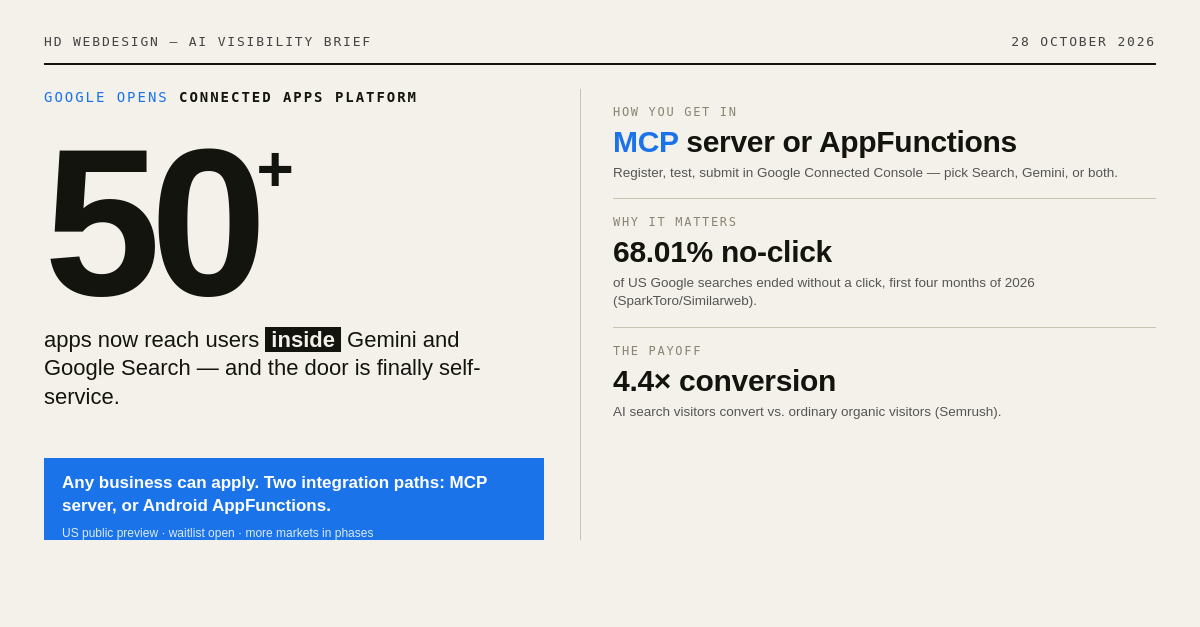
On 28 October 2026 Google opened the door it used to keep closed: any business or developer can now apply to build a Connected App that runs inside the Gemini app and inside Google Search, including AI Mode. Until this week, getting your service into that list meant being hand-picked and working directly with Google. Now there is a self-service platform, a public documentation site, and a waitlist. The technical requirement is one of two things: a cloud-hosted Model Context Protocol (MCP) server, or an Android integration through the AppFunctions APIs. The preview is live for US developers who sign up, and Google says it will open more developers, markets, and products in phases over the coming months.
Here is what the platform actually is, how the submission process works, why it matters for anyone who has spent years fighting for search rankings, and what a small business should realistically do about it this month.
What Google announced on 28 October 2026
Google published the launch on its official blog under the title "New Connected Apps Platform launches for developers," and TechCrunch covered it the same day. Three separate things were announced, and they are worth pulling apart because only one of them is news for large companies.
First, the platform itself. Developers can now build, test, register, and submit an app on their own instead of negotiating an integration with Google. Google's own description is "build once and reach high-intent users" across both Search and the Gemini app. The documentation is public at developers.google.com/connected-apps, and applications for the preview go through the Google Connected Console.
Second, existing integrations move to Search. Google says more than 50 Connected Apps are live between Search and Gemini. Partners like Adobe, Experian, Localiza, and Peloton already work in Gemini, and those same apps start rolling out to Search over the following weeks. A new integration with Calm launches on both surfaces. Search today already carries Instacart, Canva, YouTube Music, and Yahoo Fantasy Football among others.
Third, the process became visible. Before this launch, the only route into the Connected Apps list was working closely with Google, as 9to5Google noted in its coverage the same day. Most businesses did not even know the list existed, let alone that there was a door to knock on. That is the part with consequences.
How a business actually gets in
The process has three steps, and Google describes all three in the launch post:
- Integrate. Build a cloud-hosted MCP server, or implement Android MCP using the AppFunctions APIs. MCP is the open standard originally created by Anthropic and now governed as an open protocol; Google's guide covers a remote MCP server plus an OAuth 2.1 implementation so the Gemini app can act on a user's behalf only after that user links their account.
- Register, test, submit. Everything happens in the Google Connected Console: tool registration, testing, review, and publishing. You pick before review whether the app goes live in Search, in the Gemini app, or in both.
- Run it. Once live, the console reports traffic, latency, and error rates, and you keep control of brand identity, including verified logos and authenticated accounts.
Android developers have a second door. AppFunctions, shipped through the Jetpack AppFunctions SDK, lets a phone app expose its functionality to assistants like Gemini locally on the device. If your product is an Android app and you want the action to execute on the user's phone rather than on your server, that is the intended path.
One honest caveat before anyone starts building: access is being opened in phases. The preview is aimed at US developers at the start, and Google did not give a date for wider availability. Treat this as a waitlist you want to be early in, not a switch you can flip next week.
Why search people should care, not just app developers
Here is the comparison TechCrunch drew, and it is the right one: just as SEO decided which websites showed up in a ranked list, this kind of integration decides which services an AI assistant can actually reach for when someone asks. TechCrunch called the platform "one of the initial steps for businesses that want their services to be visible on the agentic web."
The shift underneath is concrete. A Connected App is not a citation. When a model cites your page, the user still has to leave the conversation, open your site, and find the button. When a user links your app once inside Gemini, your service is available inside the conversation itself: they ask, the assistant calls your tools, and the action completes without anyone navigating anywhere. Ordering groceries, building a playlist, booking a table — Google's examples are deliberately mundane, because that is where the volume is.
The numbers explain why the shift is worth chasing. US zero-click searches hit 68.01% in the first four months of 2026, and the long slide from 45% a decade ago shows the decline is older than AI Overviews, though AI accelerated it. Meanwhile Semrush's research puts AI search visitors at 4.4 times the conversion rate of ordinary organic visitors. The traffic that still arrives from AI contexts is small and unusually ready to act. Being reachable at the moment of action is worth more than being ranked in a list nobody scrolls.
If the vocabulary is new: SEO, GEO, and AIO are three different jobs, and this platform sits firmly in the third one. GEO gets your content quoted. A connected app gets your product used.
What this is not
Three corrections, because the announcement attracted some overreach.
It is not open to everyone today. US public preview, waitlist, phased markets. No timeline was published for broader access.
It is not the same as Google's Workspace MCP connectors. In September Google switched on connectors that let Gemini read data from Jira, Asana, and Salesforce. That was about your internal Workspace data. Connected Apps are about third-party services reaching end users inside Google's products.
It is not risk-free plumbing. An MCP server you expose to Google is an MCP server anyone can probe. Our earlier look at the MCP ecosystem found that up to 200,000 servers can run commands on the machine that hosts them. Google's review process, verified logos, and OAuth 2.1 requirement exist precisely because of that history — but your server's authentication and rate limits are still your responsibility.
What to do this month
Most readers do not have an Android app or a public API, and that is fine. The practical response has two layers.
If you build products: apply for the preview now. The cost of being early in a phased rollout is an email address and a waitlist entry; the cost of being late is joining a queue behind thousands of developers once the preview opens publicly. Start with the MCP server path unless you have a specific reason to run on-device. Design for OAuth 2.1 from day one, since account linking is the gate for every action that touches a user's data.
If you run a business with a website: nothing here replaces the fundamentals, it sits on top of them. An assistant cannot call a tool that describes you accurately if the public web says nothing consistent about you in the first place. The model decides what you are before it decides whether to reach for you. That layer — how ChatGPT, Gemini, and Perplexity describe your company today — is measurable in about five seconds, and it is where almost every business we look at is surprised.
See how AI tools describe your business
Free AI Visibility Card: enter your URL and get an A–F score of how ChatGPT, Gemini and Perplexity see your company, in about five seconds.
Get your free AI score →One closing thought. For twenty years the game was getting onto the first page. The next version of the game is getting into the list of things an assistant is allowed to touch. Google just published the rulebook, the docs are public, and the waitlist is short because almost nobody has read them yet. That window closes at the pace other developers catch on.
Frequently asked questions
What is Google's Connected Apps Platform?
It is a self-service platform Google launched in preview on 28 October 2026 that lets any developer or business build, register, and submit an app to run inside the Gemini app and Google Search. Developers integrate through a cloud-hosted MCP server or Android MCP with the AppFunctions APIs, manage everything in the Google Connected Console, and choose whether the app appears in Search, Gemini, or both. More than 50 Connected Apps are already live across the two surfaces.
How do I get my app into Gemini and Google Search?
Build a cloud-hosted MCP server or an Android MCP integration using the AppFunctions APIs, then register, test, and submit it through the Google Connected Console. Before review you decide whether it goes live in Search, in the Gemini app, or in both. After launch the console shows traffic, latency, and error rates. The preview is currently open to US developers who apply for the waitlist, with more markets coming in phases.
Do I need to know how to code an MCP server?
Someone does. A Connected App requires either a remote MCP server with OAuth 2.1 account linking or, for Android apps, the Jetpack AppFunctions SDK. The protocol is open and the Google documentation is public, so a competent developer can build the integration without special access from Google. If you have no developer and no API, this is not yet your channel — the content layer of AI visibility is.
Is the Connected Apps Platform available outside the United States?
The public preview started with US developers who sign up for the waitlist. Google said it will open more developers, markets, and Google products over the coming months, and did not publish a date for broader availability. Applications go through the Google Connected Console.
What does Connected Apps mean for SEO and GEO?
It adds a third layer. SEO determines which pages rank in the list, GEO determines which sources get quoted in AI answers, and connected apps determine which services an assistant can actually act through. TechCrunch compared the platform to SEO's early days as a visibility gate on the "agentic web." The two existing layers do not become less important: an assistant still needs a credible public description of your business before it has anything accurate to say about you.
Sources: Google, "New Connected Apps Platform launches for developers," 28 October 2026; Google for Developers, Connected Apps Platform documentation, accessed 2 November 2026; TechCrunch, "As AI agents reshape the web, Google opens Gemini and Search to more apps," 28 October 2026; 9to5Google, 28 October 2026; SparkToro with Similarweb clickstream data, 8 June 2026; Semrush research, March 2026; modelcontextprotocol.io, MCP specification.