
Gemini now reads your Jira, Asana and Salesforce data. Here's what that changes
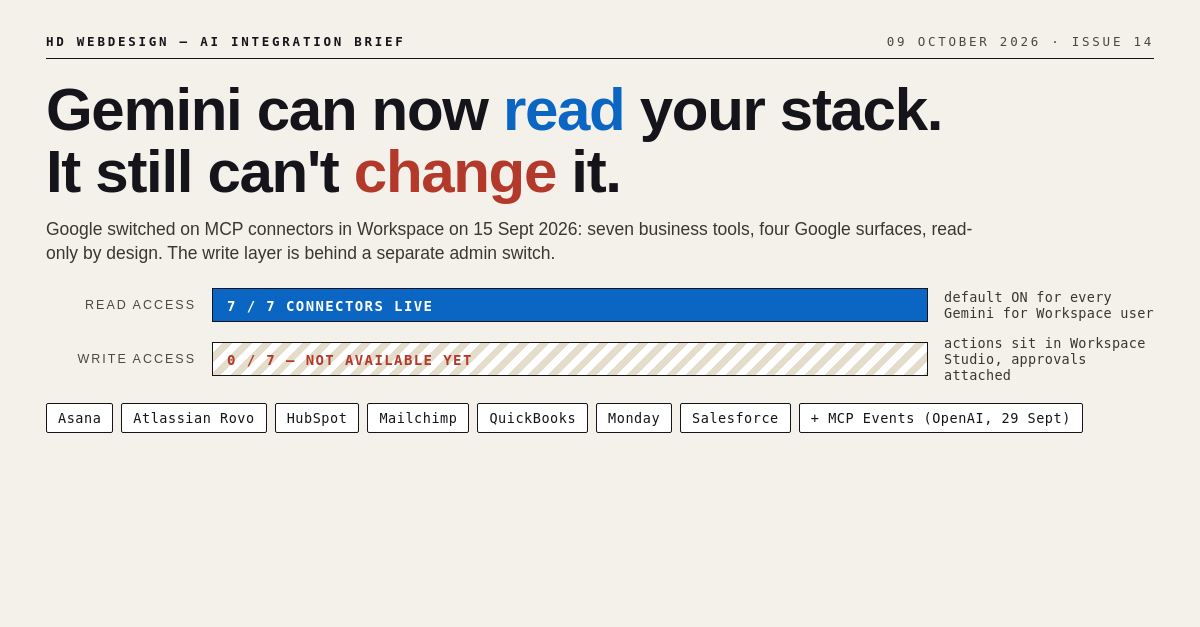
On 15 September 2026 Google switched on MCP connectors between Gemini in Google Workspace and seven business tools: Asana, Atlassian Rovo, HubSpot, Intuit Mailchimp, Intuit QuickBooks, Monday and Salesforce. The connectors are on by default for anyone with Gemini for Google Workspace, they live in the side panel of Docs, Sheets and Slides and inside Google Chat, and they read. That is the honest summary of the feature: Gemini can tell you which Asana tasks are due today, which Jira issues are blocked and which Salesforce opportunities are open, without you switching tabs. It cannot close a task, move an issue or edit a record. Not yet.
What exactly changed in Google Workspace?
Google's own Workspace Updates blog announced the change on 15 September 2026. Users can now ask Gemini to pull live information from Asana, Atlassian Rovo, HubSpot, Intuit Mailchimp, Intuit QuickBooks, Monday and Salesforce through Model Context Protocol (MCP) integrations. The stated goal is that people get information "without needing to switch tabs, download files, or interrupt workflows."
Three details matter more than the headline. First, the connectors are on by default for every user with Gemini for Google Workspace access, and admins control them at the domain, organisational unit or group level. Second, on 30 September 2026 Google published a correction: the admin path in its original instructions was wrong, and connector access actually lives under Apps > Google Workspace Marketplace apps > Apps list. If your documentation was written in mid-September, it is out of date. Third, the rollout is not uniform. Google lists Business Standard and Plus, Enterprise Standard and Plus, Enterprise Essentials Plus and certain Education add-ons, while a later wave of "Connected Apps" (Airtable, Linear, PandaDoc, Zoho, added 23 September 2026) varies by account type, location and language, as UC Today reported on 8 October 2026.
A typical morning with this feature looks like asking Gemini which Asana tasks are due first, opening a Jira issue through Rovo in the same conversation, then checking an open Salesforce opportunity. All three answers arrive in the place where you already write your email.
Why can Gemini read your data but not change it?
Because Google split the feature into two products on purpose. The Workspace connectors handle context, where a mistake costs you a wrong answer. Workspace Studio handles action, where a mistake costs you a corrupted record. On 17 September 2026 Studio added custom starters, webhooks, workflow steps and action-capable integrations with Asana, Jira, Salesforce and Slack; Google's own example is adding a comment to a Jira issue. Custom steps, third-party integrations and webhooks are off by default and carry separate admin approval controls (UC Today, 8 October 2026).
Microsoft made the same call from the other direction. Its Work IQ MCP server exposes Microsoft 365 to outside agents, and Microsoft's documentation is explicit about the safety default: the server uses Microsoft Entra authentication and the signed-in user's Microsoft 365 permissions, "a separate tenant policy layer evaluates each tool request and blocks mutation operations by default." Create, update and delete requests stay blocked until an administrator enables them through tenant policy.
So the industry answer to "should an AI be allowed to write?" in September 2026 was: read first, write later, behind an admin switch and a human approval. That is a much more sensible default than it sounds. Read-only access is hard to regret. Write access is how you end up explaining to a client why a Jira sprint was closed by mistake.
MCP became the standard while nobody was watching
MCP gives AI clients one common way to discover the data and actions an application exposes, instead of every vendor building a bespoke connector for every AI tool. Three things happened in the last month that pushed it from developer plumbing to procurement question:
- On 14 September 2026 the Linux Foundation-backed Agentic AI Foundation launched the first official MCP certification (MCPA), aimed at validating professional expertise in the protocol.
- On 29 September 2026 OpenAI shipped MCP Events at DevDay: ChatGPT can subscribe to updates from an MCP server and start working when something changes in a connected app, instead of waiting for someone to ask. OpenAI's own example is a new task appearing on a project board triggering ChatGPT to read the linked material and draft a plan.
- Google is pushing MCP further down its own stack, including the ability to expose existing REST operations as MCP tools through Cloud API Gateway while keeping authentication, quotas and logging (UC Today, 8 October 2026).
One related move sits next to the connector story. Google published how Skills work in Workspace on 17 September 2026: reusable instructions that live in a document, get tested in Workspace Studio and can encode things like brand voice or invoice review steps, as the Workspace Blog explains. Skills are built on the open SKILL.md format, and Google has since mapped out a timeline for retiring Gems in their favour (UC Today, 8 October 2026). If MCP standardises what an agent can reach, Skills standardise how a repeated job gets done.
The practical effect is that where the work lives and where you ask about the work are becoming two different places. A project platform no longer owns the front door.
Who owns the workflow when the assistant sits in another app?
This is the question the update actually raises, and every major vendor answered it differently in the same fortnight, as UC Today's reporting on 8 October 2026 lays out:
- Atlassian turned Rovo MCP v2 general availability on 8 September 2026 and added more than 20 Jira tools covering boards, sprints, comments, worklogs and dashboards, plus read and write toolsets for capacity planning on 24 September 2026. It also lets admins govern MCP access through Data Security Policy rules based on app, space and data classification. Jira wants to stay where agents are assigned and governed.
- Asana is defending the context layer with more than 30 AI Teammates that carry their own permissions and audit trails, and automation rules that now run using the owner's current permissions rather than the rights they had when the rule was written. Its chief product officer's framing: "Agentic coding needs an orchestration layer."
- Smartsheet went the other way and let every major assistant in. By June, more than 22,000 users had generated three million AI actions through its MCP Server, with close to one in three creating or changing live work. Its product chief's take is the sharpest line in the piece: "The problem most teams run into isn't access to AI. It's that their AI has no idea how your organization actually works."
Read those three together and the pattern is clear. The interface is becoming interchangeable. Trusted context, permissions and audit trails are not. That is also why permission problems are now the security story: we looked at what to audit before you connect an MCP server earlier this month, and the same checklist applies to a connector you switch on by default.
What admins should check this week
- Separate reading from doing in your head and in your tenant. Workspace connectors retrieve third-party data. Workspace Studio and Gemini Enterprise carry the action capabilities, and their custom steps, webhooks and third-party integrations start off with approval controls attached.
- Open Apps > Google Workspace Marketplace apps > Apps list and see which connectors are live for which organisational units. Google's own documentation changed here on 30 September 2026, so an old screenshot is not evidence.
- Check what sits behind each connector. Marketplace settings, paid plans and helper apps all affect what an integration can really do; Salesforce and Monday may require an additional helper app before anything works.
- Plan for people leaving. Gemini Enterprise admins can transfer a shared agent to another owner, and schedules or event triggers are disabled during the transfer. Someone will leave with three agents they created, and someone will have to inherit them.
What this means if you run a smaller business
You probably do not have a Jira estate and a Salesforce pipeline to connect. The part that applies anyway is the direction of travel: assistants are moving from answering questions to holding context across your tools, and permissions decide what they are allowed to touch. If your team's work lives in SaaS products, the permission screen in those products is now a business policy document, not an IT detail.
There is a second, quieter point. The integration layer is starting to outlive the model layer. OpenAI shipped new models on 22 September 2026, Anthropic shipped Claude Opus 5.5 the same day, and enterprise teams had to retest workflows, recheck costs and re-run security review within weeks. A connector that survives a model swap saves you that work every time. That is the argument for building on open protocols rather than on whichever assistant is fastest this month.
And the mirror image of all this applies to your customers. If assistants can reach live data inside companies, they are also deciding which companies to mention. If you do not know how ChatGPT, Gemini and Perplexity currently describe your business, that is the first thing to check.
See how AI tools describe your business
Free AI Visibility Card: enter your URL and get an A–F score of how ChatGPT, Gemini and Perplexity see your company, in about five seconds.
Get your free AI score →Frequently asked questions
What are Gemini's new MCP connectors in Google Workspace?
They are integrations, announced on 15 September 2026, that let Gemini in Google Workspace pull live information from Asana, Atlassian Rovo, HubSpot, Intuit Mailchimp, Intuit QuickBooks, Monday and Salesforce using the Model Context Protocol. You reach them from the Gemini side panel in Docs, Sheets and Slides and inside Google Chat.
Are the connectors enabled by default?
Yes. Google says the feature is ON by default for users with Gemini for Google Workspace access. Admins manage it under Apps > Google Workspace Marketplace apps > Apps list, at the domain, organisational unit or group level. Google corrected that click path on 30 September 2026.
Can Gemini change data in Jira, Asana or Salesforce?
Not through these seven connectors, which support read actions only as of October 2026. Writing happens in other products: Workspace Studio can trigger and change work across services such as Asana, Jira and Salesforce, and Gemini Enterprise has its own action-enabled connections. On Microsoft's side, Work IQ MCP blocks mutation operations by default until an admin enables them.
What is MCP and why does it matter for business software?
Model Context Protocol is an open standard that lets an AI client discover the data and actions an application exposes. It matters because one connector works with many assistants instead of every vendor building separate integrations for each AI tool, and because the Linux Foundation-backed Agentic AI Foundation launched the first official MCP certification on 14 September 2026.
What should an administrator check before AI agents get write access?
Four things: which connectors are enabled and for which groups, which additional helper apps or paid plans each connector needs, whether approval steps are required for actions that modify external data, and who inherits shared agents when an employee leaves. Permissions inherited from the signed-in user should stay the baseline, with tenant policy layered on top.
Sources: Google Workspace Updates, 15 September 2026 and 30 September 2026 correction; Google Workspace Blog, 10 and 17 September 2026; Microsoft Learn, Work IQ MCP documentation; OpenAI DevDay 2026 and MCP Events documentation; Linux Foundation press release, 14 September 2026; UC Today, 8 October 2026.