
Will Your Website Still Matter in 2027? What AI Agents Do Instead of Browsing
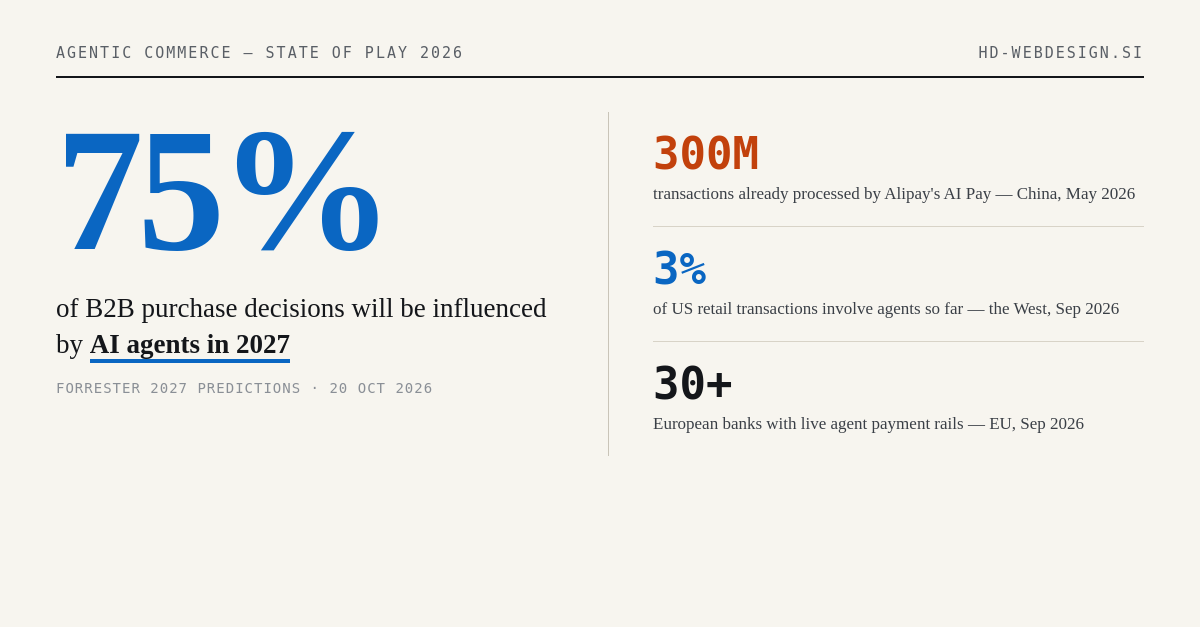
Short answer: no, websites do not become irrelevant in 2027 — but websites that an AI agent cannot read, verify or transact with quietly stop being found and stop being bought from. The shift is no longer about citations in AI answers. Agents are now the second visitor to your site, and they shop, book and pay. Forrester's 2027 B2B go-to-market predictions, published 20 October 2026, estimate that AI agents will influence 75% of B2B purchase decisions next year, and that two thirds of vendors will lose deals because buyers cannot verify their claims.
That last number should sit with you for a second. The loss is not caused by bad products. It is caused by claims a machine cannot check.
Your store now has a second kind of buyer
An agent that shops on your behalf does not care about your hero video. It reads structured product data, checks that the price is current, checks that the item is in stock, and looks for a checkout it can complete. If any of those four are missing, it moves to the next store.
IDC put numbers on this in an InfoBrief published 3 August 2026 (sponsored by WooCommerce, so read it with that in mind): AI is projected to replatform $500 billion in digital spending by 2030, agent use among Global 2000 companies is expected to grow tenfold by 2027, and brands that are not ready risk losing access to a quarter of their market. The report's framing is the useful part: "Every store now has a second kind of buyer."
MIT Technology Review's essay "The agentic web is here," dated 2 November 2026, makes the same observation from the publisher side: Time now publishes versions of its articles that are easier for agents to parse and sells ads targeted at them, while Etsy and Expedia have partnered with the major AI firms so agents can interface with their services directly. The web is being rebuilt in two layers, and only one of them is for humans.
Shopping: the checkout is the bottleneck, not the search
Agents are already good at finding products. Completing the purchase is where it breaks. According to PYMNTS data cited in a 17 September 2026 analysis, 132 million US adults have used AI to assist with a retail purchase, yet only 3% of transactions currently involve agents. The reason is fragmentation: merchants face five competing checkout standards — Visa Intelligent Commerce, Mastercard Agent Pay, Stripe's Agentic Commerce Protocol, Google's Universal Commerce Protocol and AP2, and Meta's Muse — with integration costs estimated between $5,000 and $500,000 per protocol. The piece calls it a "protocol proliferation tax," and it is the main reason your agent-ready store does not exist yet.
Two retailers showed where the power struggle sits. In September 2026, Amazon blocked Meta's Muse agent from shopping on its site, arguing the agent did not identify itself and appeared to capture customer credentials; Amazon's $68 billion advertising business depends on humans browsing. One day later, Shopify went the other way and enabled agentic checkout with Shop Pay across roughly a million merchants. Shopify reported that AI-driven traffic and orders to its stores tripled year over year in Q2 2026, and that shoppers who start with an AI model land on a product page about 2.5 times more often, converting roughly 80% higher.
Read that as a merchant and the implication is blunt. If you run on Shopify, the agent channel is switching on whether you asked for it or not. If you run a custom store or WooCommerce without structured data and an agent-completable checkout, an agent that finds your product cannot buy it — and it will buy from the store next door instead.
Reservations: the platforms want the agent to stay inside
Travel and restaurants are moving the same way, except the battleground is who owns the booking. Airbnb told shareholders on 5 November 2026 that it will roll out an AI agent for trip planning and booking in the first half of 2027, handling discovery, booking, changes and payments entirely inside Airbnb — its stated advantage being that an outside agent cannot change a reservation or process a refund. Booking Holdings has committed $100 million to its Vayo AI and launched the agent Lola, while Expedia is publicly betting against the all-powerful travel agent.
Restaurants are already feeling it. Zest launched an agent that finds restaurants and books tables over text (TechCrunch, 30 October 2026), Yelp's agent phones venues to secure a table, and OpenTable's CEO has been talking about agent partnerships that bring in new diners. In September, PCMAG and NBC reported that diners are starting to compete with agents for popular time slots. None of these agents read your beautiful photo gallery. They read availability, and they read it wherever it is structured best.
Three different directions: China, the US and the EU
It helps to see that the rest of the world is not converging on one answer.
China runs on platform-owned agents. Alibaba's Qwen assistant completed what the company calls the industry's first full AI shopping loop in May 2026: you chat, it compares, it orders on Taobao and pays with Alipay. By the end of February 2026, Alibaba reported roughly 140 million users had tried AI shopping through Qwen. Tencent's secret WeChat agent, reported in March 2026, is designed to operate millions of mini-programs — Didi, Meituan, Ctrip — for 1.4 billion users. And Alipay's AI Pay passed 100 million users and 300 million transactions by May 2026. The Chinese consumer does not deploy a personal agent that wanders the open web; the assistant lives inside the app, because the same company owns the agent, the store and the payment rail. A Chinese store does not need an agent-ready website, because there is barely a website in the loop at all.
The US is the wild west of protocols. Independent agents from Meta, OpenAI and Anthropic go shopping on other companies' territory, which is why you get credential fights, blocked crawlers and five incompatible checkout standards.
The EU is building open rails with regulation. Live end-to-end agent payments already run across more than 30 European banks — Santander, Mastercard, ING and Worldline have executed them, with ING, Worldline and Visa completing a biometric agent payment in Germany on 2 July 2026 — all riding the PSD3/PSR open banking framework, which is forcing a new "Know Your Agent" discipline on banks. Meanwhile the AI Act's transparency rules are in force and the DMA keeps widening. Europe is deliberately not allowing the Chinese closed-loop model, which means third-party agents must be able to reach and transact with independent sites. That is good news for anyone with their own domain, provided the site can actually be read and completed.
The direction of travel is the same in all three: the interface layer concentrates into a few assistants, while the open web survives as the layer those assistants have to reach through. Zalando's new "Zalando Extended" agent, launched 3 November 2026, already lets people buy from other retailers' shops through the Zalando app — a European preview of what "inside the platform" means for a small merchant's margins.
What agent-ready actually means for your site
Forget the buzzword; the checklist is short and most of it is unglamorous work.
- Readable without a browser. Server-rendered HTML, real text, no walls of JavaScript between the agent and the price. Structured data (schema.org, JSON-LD) for products, availability and opening hours.
- Verifiable facts. Current prices, live stock, consistent NAP data, proof points a machine can cross-check. This is what Forrester means by restructuring content discovery for AI: credible, indexable, consistent claims.
- Accessible. AudioEye's September 2026 study found up to a 68% drop in agent task completion on inaccessible websites. Accessibility compliance is now also an agent compatibility requirement.
- Crawlable on purpose. Decide explicitly which AI crawlers you allow (GPTBot, ClaudeBot, PerplexityBot, Google-Extended) instead of blocking everything by reflex. A blanket robots.txt block is a decision to be invisible.
- Completable. For a shop: an agent can go from product to paid order. For a restaurant or hotel: an agent can read availability and complete a booking. Until you have that, the checkout five competing standards are fighting over is someone else's problem. Until it is yours.
The traffic context makes this less academic. Google search traffic to publishers fell 40% year over year as of September 2026, AI chatbots already reach one in ten news readers while only 4% of them click through to the source, and TNW reported in May 2026 that AI Overviews cut publisher clicks by 58%. Whatever you think of those numbers individually, the direction is not in dispute: fewer people arrive by browsing, more arrive — if they arrive at all — through an answer machine that decided what to tell them about you before you got a chance to speak.
The missing layer: giving agents something to call
There is a useful way to read that checklist: a site has to pass three gates. It must be readable (an agent can parse you), verifiable (an agent can trust your claims) and executable (an agent can act with you). GEO work mostly wins the second gate. The third gate is newer and emptier, and it is where MCP enters: the Model Context Protocol, Anthropic's open standard for connecting AI models to tools and data, is how an agent moves from reading about you to calling you. Google opened its Connected Apps Platform on 28 October 2026 so assistants can pull from third-party services over MCP, Uber put more than 800 internal services behind a single MCP gateway, and WooCommerce now ships MCP support so agents can query catalogs directly.
The practical version of this is smaller than it sounds. A shop can expose products and stock; a restaurant can expose opening hours and free tables; a service business can expose prices and slots — in a form an assistant calls instead of scrapes. One documented endpoint with your real data is enough to become the business an agent can finish a task with, rather than the one it gives up on. We wrote more about what to audit before connecting an AI agent to your systems after researchers found up to 200,000 exposed MCP servers.
What the third layer costs, and what it returns
The natural next question is what all of this does to the price of a website. Two of the three layers already have a market rate; the third barely does. GEO work at agencies currently runs $1,500 to $10,000 a month in retainers, according to PageTraffic's 2026 GEO pricing guide, with fixed audits advertised from $99 and managed campaigns up to $3,490 a month (agency pricing overview, 2026). Two quotes for what looks like the same work can differ by an order of magnitude — that is what happens when a discipline is two years old.
Layer by layer: the human layer — design, build, launch — is stable at roughly €890 to €3,490 for a serious small-business site, plus a modest monthly maintenance fee. The visibility layer is where quotes diverge most: our AI Authority Foundation runs from €699 as a one-time engagement, deliberately below the $1,500–10,000 monthly retainers charged abroad. The action layer is the newest and least standardized: a one-off setup (structured feeds, an MCP endpoint, an agent-tested checkout or booking) plus a small monthly fee to keep data fresh and the endpoint monitored — tens of euros a month, not thousands. A complete three-layer project typically lands about a third above the bare site price, and the monthly running cost roughly doubles.
Against what it returns, the arithmetic is not close. Forrester's 2027 prediction — two thirds of B2B vendors losing deals because buyers cannot verify their claims — means one deal won by being the company an AI can check and complete a purchase with pays for the setup several times over. The action layer is still rare (about 3% of transactions run through agents today), so businesses that ship it first stay ahead for years, not months. And if budgets are tight — they usually are, especially in Slovenia compared with DACH — the order is simple: free AI Izkaznica first, visibility layer next, action layer when the first AI-sourced lead arrives.
Want to see how your site looks in AI search?
Free AI Izkaznica — enter a URL and see how ChatGPT, Gemini and Perplexity describe your business.
Get your free AI score →Frequently asked questions
Will websites be obsolete in 2027 because of AI agents?
No. Websites remain the substrate that assistants retrieve from, quote and link to. What changes is who reads them: in addition to human visitors, sites are read by agents that check structured data, prices, availability and trust signals. A site that cannot be read or verified by an agent does not become obsolete in the sense of being switched off — it becomes invisible to an entire growing channel of buyers.
What is agentic commerce?
Agentic commerce is shopping where an autonomous AI agent performs the purchase for a person: comparing products across stores, checking stock and price, and completing checkout. As of September 2026, 132 million US adults had used AI to help with a purchase, but only about 3% of transactions ran through agents, held back by five competing checkout standards (Visa, Mastercard, Stripe, Google, Meta). Shopify enabled agentic checkout with Shop Pay for around a million merchants in September 2026.
How do I make my website ready for AI agents?
Five things, in order of impact: serve real server-rendered HTML with schema.org structured data; keep prices, stock and availability current and machine-readable; pass an accessibility audit (agent task completion drops up to 68% on inaccessible sites); allow the AI crawlers you want to be found by in robots.txt; and give agents a completable action — a working checkout for shops, readable availability and booking for hospitality. The free AI Izkaznica shows how AI currently sees your business.
Do AI agents book restaurants and hotels too, not just products?
Yes. Airbnb is rolling out an AI agent for planning and booking trips in the first half of 2027, Booking Holdings has invested $100 million in travel AI, and agents like Zest and Yelp's assistant already reserve restaurant tables. The practical consequence is that availability data — not a photo gallery — is what makes a venue findable and bookable by an agent.
Is this different in Europe than in the US or China?
Yes. China's transactions happen inside platform-owned assistants (Qwen, WeChat, Alipay), the US market is a fragmented fight between independent agents and five checkout protocols, and the EU is building regulated open rails — agent payments live across 30+ banks under PSD3/PSR, with AI Act transparency rules applying. For European businesses the open web stays alive, so both open-web readiness and platform presence matter.
Sources: Forrester, "2027 B2B Go-to-Market Predictions" (via FutureCIO, 2 November 2026); MIT Technology Review, "The agentic web is here," 2 November 2026; Search Engine Journal / Chartbeat, "Google Search Decline Steepened To 40% YoY For Publishers," 24 September 2026; AudioEye study via PR Newswire, 24 September 2026; PYMNTS data and protocol analysis, Yahoo Finance, 17 September 2026; Motley Fool on Amazon vs Shopify, 23 September 2026; Unite.AI on Airbnb's Q3 2026 shareholder letter, 5 November 2026; TechCrunch on Zest, 30 October 2026; IDC InfoBrief sponsored by WooCommerce, 3 August 2026; Alipay press release, 26 May 2026; The Paper on Qwen × Taobao, 11 May 2026; BigGo Finance on Tencent's WeChat agent, 11 March 2026; Yahoo Finance, "Europe Has Agent Payment Rails Live Across 30+ Banks," 18 September 2026; Analytics Insight on Zalando Extended, 3 November 2026; The Next Web on AI Overviews publisher clicks, 6 May 2026; TechTimes on AI chatbot news readership, 22 June 2026.