
The MCP Gateway Wave: Why Uber, AWS, Oracle and Snowflake All Built One
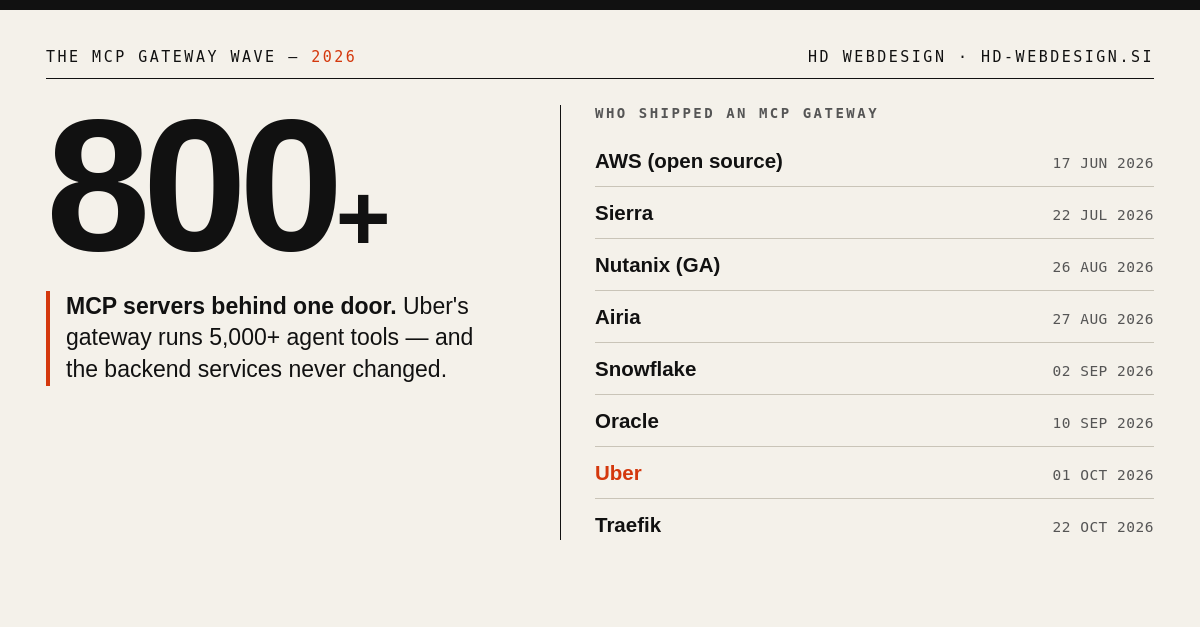
An MCP gateway is one controlled door between AI agents and the services they are allowed to call. Uber put one in front of more than 800 MCP servers and 5,000 tools, described the design in an engineering post on 1 October 2026, and InfoQ covered it on 2 November. Uber is not the only one: AWS, Oracle, Snowflake, Sierra, Nutanix, Traefik and Airia all shipped MCP gateway products during 2026. Every one of them converges on the same trick — take the APIs you already have, publish them as tools, change nothing in the backend, and put a single governed door in front of everything an agent can touch.
That last part is the whole point. Companies spent twenty years building API gateways to control how software talks to software. Now the same companies are building the same control point for how AI talks to software. The difference is the caller.
What Uber actually built
Uber's gateway has two halves. The MCP Registry is the control plane: a catalog of servers, tools, schemas, owners and enablement flags. The Proxy Gateway is the data plane: when an agent sends an MCP request, the proxy translates it into HTTP, gRPC or TChannel, forwards it to the real service, and converts the answer back into MCP format (Uber Engineering, 1 October 2026). The services themselves never learn that agents exist.
The clever part is how tools get into the catalog. Nobody at Uber wants to hand-write MCP servers for thousands of internal services, so they built AutoCrawler, a workflow system that continuously scans the company's interface definition registry. It reads Protobuf and Thrift schemas, extracts method names and documentation, and asks an LLM to write agent-friendly tool descriptions. Then it registers everything in a disabled state.
Uber states the principle plainly: discovery doesn't imply exposure. A crawler can find your service, generate perfect tool definitions, and the tools still do nothing until a human on the owning team reviews the diff and clicks enable. Configuration changes propagate to the running proxy without restarts. Access control sits at both server and tool level, PII is redacted from responses, and third-party integrations like Jira and Google go through a separate token exchange so internal credentials never leave the building.
Seven other companies shipped one in 2026
The Uber post is the loudest, but the pattern has been accumulating all year:
- AWS open-sourced MCP Gateway and Registry under Apache 2.0 on 17 June 2026 — a catalog with a gateway, identity integration with Entra ID, Okta and Cognito, security scanning through Cisco AI Defense, and federation with other registries including Anthropic's.
- Sierra, the AI agent company, published "Building Sierra's MCP Gateway: An engineering iceberg" on 22 July 2026.
- Nutanix shipped a generally available MCP gateway in Enterprise AI 2.8 on 26 August 2026.
- Airia added intelligent routing and enterprise access controls to its MCP gateway on 27 August 2026.
- Snowflake published "The Enterprise Guide to MCP Gateways" on 2 September 2026.
- Oracle launched the Oracle Integration MCP Gateway on 10 September 2026 for governed agent access.
- Traefik, whose reverse proxy already fronts a large share of cloud traffic, introduced the Traefik MCP Server on 22 October 2026.
Read that list again with vendor categories in mind: a ride-hailing company, two cloud majors, a data platform, an agent startup, a virtualization vendor, an API management player and a proxy vendor. When infrastructure companies that compete on everything else build the same component independently, the component has become table stakes.
"This is just an API gateway with a new name"
Plenty of engineers said exactly that, and they are not wrong. InfoQ ran the argument in August under the headline "MCP Goes Stateless, and Developers Ask Whether That Just Makes it an API Again." On LinkedIn, Ajay Sharma, principal engineer at Microsoft CoreAI, wrote that Azure API Gateways has been doing this for a while and called it "a recipe for order to the chaos that LLMs come with." Kelly Goetsch at Pipe17 put it sharper: Uber's gateway "looks identical to gateways we've built over the decades for APIs and later GraphQL." Tamir Dresher pointed out that security, discovery, observability and governance are the same distributed systems problems they always were.
Here is where I come down: the resemblance is the feature, not the embarrassment. Enterprises adopt what their architects already understand. An MCP gateway reuses twenty years of API gateway thinking — authentication, rate limits, audit logs, policy at the edge — and adds the two things agents need on top: machine-readable discovery of tools, and schemas trimmed down to what a model can actually use. If MCP had arrived demanding a brand new infrastructure category, it would be dying the slow death most new categories die. Because it arrived looking familiar, platform teams can approve it without relearning their job.
The problem that only shows up at scale
Uber's most useful section is the one about what broke when they crossed thousands of tools. MCP has no native cross-server search: an agent must already know which server to ask before it can list tools, and stuffing thousands of tool definitions into the context window eats the budget the model needs for actual work. Their fixes are worth stealing regardless of company size.
Omni MCP exposes four meta-tools — discover servers by intent, look up a server's tools, fetch one tool's schema, invoke it — so agents search first and load only what they need. Response Projection lets the caller ask for specific response fields instead of full payloads, the way GraphQL did for REST. Code Mode routes MCP calls through Uber's aifx command-line tool so coding agents write results to files and grep them, loading nothing into context until it matters. Uber says Code Mode is now the company default for MCP tool use in coding agents.
None of that exists to impress architects. It exists because the naive version — give the agent everything — stops working the moment the catalog gets serious.
Why this matters if you run a business, not a platform team
You will never operate 800 MCP servers. You will, however, be on the other side of this shift from three directions.
As a consumer of gateways. Google opened its Connected Apps Platform on 28 October 2026, so assistants can pull data from third-party services through MCP — we covered what that means for getting a business into Gemini and Search. The enterprise version of the same idea is that an agent working for your partner, your bank or your supplier will reach your systems through a governed gateway, and the entry requirements will look a lot like Uber's: a documented schema, an owner, an audit trail.
As a target of agents. We already wrote about the audit checklist for MCP servers after researchers found up to 200,000 of them exposed. The gateway wave is the industry's answer to that mess: one front door with authorization and redaction instead of a hundred servers with inconsistent rules. When a vendor pitches you an "AI integration" in 2027, the serious ones will show you where the gateway is.
As a publisher. If you want assistants to use your booking, catalog or pricing data, you publish it in a form agents can discover — which is exactly what Uber's registry does internally, at a scale you can borrow the idea from without borrowing the scale.
What to do this month
- Write down what an agent could already reach. Public APIs, booking widgets, a pricing PDF, a Google Calendar. Anything reachable is a tool, whether or not anyone named it that.
- Adopt the disabled-by-default rule now. Uber's best idea costs nothing: nothing goes live until a named owner approves it. Teams of five can keep that rule in a spreadsheet.
- Insist on an audit trail before anything connects. Who called which tool, with what parameters, when. If a vendor's integration can't answer that, it isn't governed, it's just open.
- See how AI describes you today. Before agents get a gateway to your data, they work from what is already public. The free AI Izkaznica shows how ChatGPT, Gemini and Perplexity currently describe your business — the answer takes five seconds and often explains a lot.
Want to see how your site looks in AI search?
Free AI Izkaznica — enter a URL and see how ChatGPT, Gemini and Perplexity describe your business.
Get your free AI score →Frequently asked questions
What is an MCP gateway?
An MCP gateway is a single service that sits between AI agents and the tools they call. It translates MCP requests into whatever protocol the backend speaks (HTTP, gRPC or others), enforces authorization at server and tool level, redacts sensitive data from responses, and keeps a registry of which tools exist, who owns them and which are enabled. Uber runs one in production for more than 800 MCP servers and 5,000 tools; AWS offers an open-source version under Apache 2.0.
Is an MCP gateway just an API gateway with a new name?
Mostly yes, and that is deliberate. It reuses the familiar edge patterns — authentication, rate limiting, audit logging, policy — and adds what agents need on top: machine-readable tool discovery, JSON schemas for model context, incremental discovery so agents do not load thousands of tool definitions, and response projection to keep payloads small. Engineers from Microsoft and API management vendors publicly made the comparison in August and November 2026.
Why did Uber build its own instead of buying one?
Uber's backend spans thousands of internal services speaking HTTP, gRPC and TChannel behind its own service mesh and access control system. A commercial gateway would still need deep integration with all of that, so Uber built the registry and proxy around existing infrastructure and used AutoCrawler to generate tool definitions from Protobuf and Thrift schemas automatically. Companies with heterogeneous internal platforms tend to make the same call.
How many companies have an MCP gateway in 2026?
At least eight shipped or published one during 2026: Uber (design post 1 October), AWS (17 June, open source), Sierra (22 July), Nutanix (26 August, generally available), Airia (27 August), Snowflake (2 September), Oracle (10 September) and Traefik (22 October). The count keeps growing as gateway and API management vendors fold MCP support into existing products.
Does a small business need an MCP gateway?
Not to run one. Small companies feel this shift as consumers: assistants and partner systems will reach your data through governed connections, and the practical requirements are a documented schema, a named owner, an audit trail and nothing exposed by default. You can apply Uber's governance rules to your own APIs without building Uber's infrastructure, and the first step is knowing how AI currently represents your business.
Sources: Uber Engineering, "Designing MCP Gateway: Uber's MCP Management Platform," 1 October 2026; InfoQ, "Uber Builds MCP Gateway to Govern Access to 800+ Servers and 5,000+ AI Agent Tools," 2 November 2026; InfoQ, "MCP Goes Stateless, and Developers Ask Whether That Just Makes it an API Again," 12 August 2026; AWS Open Source Blog, "Governing AI Assets at Scale with MCP Gateway and Registry," 17 June 2026; Oracle Blogs, "Introducing Oracle Integration MCP Gateway," 10 September 2026; Snowflake, "The Enterprise Guide to MCP Gateways," 2 September 2026; Sierra, "Building Sierra's MCP Gateway," 22 July 2026; StorageReview, Nutanix Enterprise AI 2.8, 26 August 2026; GlobeNewswire, Airia, 27 August 2026; Yahoo Finance, Traefik Labs, 22 October 2026.