
Who Owns GEO? IBM's Answer to the Turf War No One's Winning
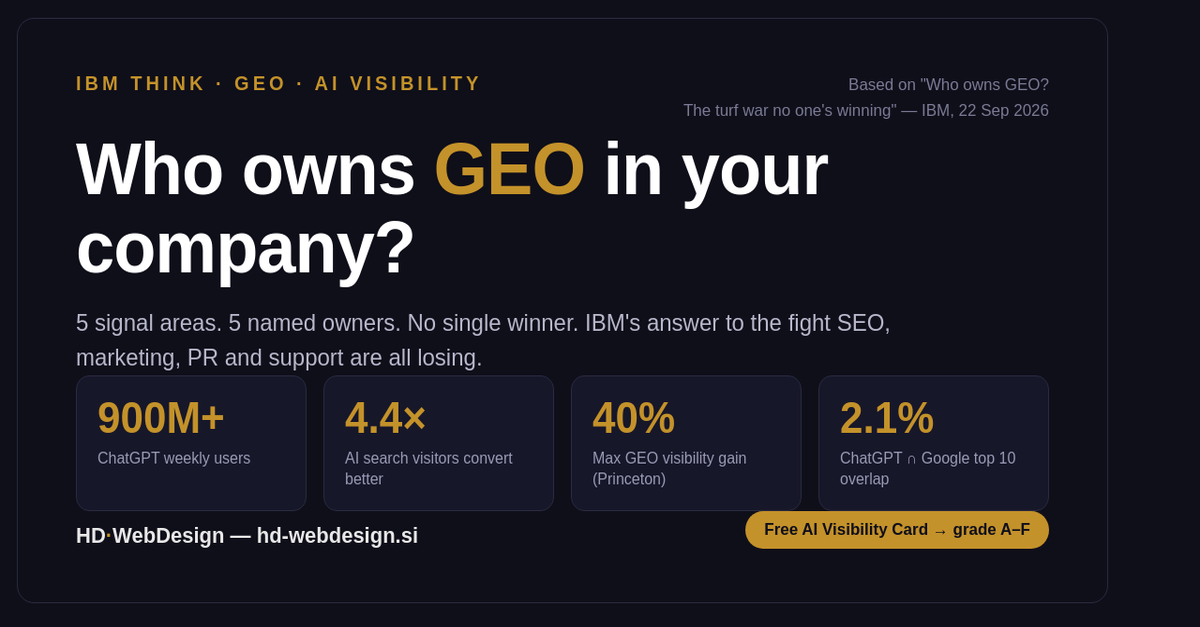
Nobody owns GEO in most companies, and that is exactly why it stalls. Generative engine optimization sits between SEO, marketing, PR, product and customer service. Every department has a credible claim, no department has the mandate, and the AI answer gets stitched together from whatever the company happens to produce. In his 22 September 2026 IBM Think article, Alexis Zamkow calls this "the turf war no one's winning" and argues that the answer is not to pick one winning department. Give each of five signal areas a clear owner, put one person in charge of the connective view, fund the work properly, and measure whether you show up in the answer instead of only whether you rank.
Source: Semrush, March 2026
Source: Semrush research
Source: Princeton, KDD 2024
Source: February 2026 sample of SaaS queries
The meeting that ends with no owner
Zamkow opens with a scene that will feel familiar. Someone puts a slide on the screen at a Tuesday meeting. It shows citations from ChatGPT and Perplexity converting better than ordinary organic traffic. Heads nod. Everyone agrees it matters. Then the meeting ends and nobody has decided whose job it actually is.
We see the same pattern in smaller companies, just with fewer people around the table. GEO jumped up the priority list because the numbers got hard to ignore. AI search visitors convert 4.4 times better than regular search visitors, and ChatGPT now has more than 900 million weekly users. The demand is real. The org chart did not keep up.
Why every team has a credible claim
The fight exists because nobody is wrong. The website team controls crawlability, schema and site structure, so an engine can find and parse the content. Marketing controls intent, brand voice and the content that helps a customer choose. PR controls earned coverage, and third-party mentions carry more weight with AI engines than a brand's own blog posts. Customer service hears the actual questions customers ask, in their own words, before those questions ever become search queries.
Each of those is a real input to how an AI engine describes your company. Give the mandate to any single team and it will optimize the slice it controls while the other four slices drift. A technically perfect site can still produce an incomplete answer. Strong press coverage is worth little if your own product pages contradict it. Good content stays invisible when the crawler cannot read it.
The five signals AI engines actually combine
IBM breaks GEO into five areas, each with a natural owner:
- External authority — PR and communications own earned coverage and third-party validation.
- Brand and content — marketing and sales own citable, well-structured content built for AI extraction.
- Technical — SEO and engineering own schema, crawlability and site architecture.
- Product and service — product marketing owns how the product is named and documented.
- Customer understanding — customer service owns support content, Q&A libraries and frontline insight into what people ask.
The AI engine combines all five whether your organization does or not. That is the part people miss. You do not get to choose which signals count. You only get to choose whether those signals agree with each other.
Why picking one owner does not work
The obvious move is to hand GEO to whoever already owns search. It fails for a structural reason: no single team controls all five signals. Marketing cannot fix schema. Engineering cannot manufacture earned media. PR cannot rewrite the product documentation. Strength in one area does not cover a gap in another.
There is also a measurement problem. Search traffic tells you about clicks. It does not tell you whether an AI engine found you, cited you, or represented you accurately. In a February 2026 sample of SaaS queries, ChatGPT's sources overlapped Google's top ten just 2.1% of the time. Ranking well in Google and being invisible to ChatGPT are not opposites; they are the normal state of affairs. We covered that gap in more detail in How does ChatGPT choose sources?.
IBM's five-step prescription
Zamkow's proposal is less about structure and more about accountability:
- Give each part of GEO a clear owner. Cross-functional does not mean ownerless. PR owns external authority, marketing owns content, engineering owns the technical layer, product marketing owns product information, support owns customer understanding.
- Give someone the connective view. One person needs visibility across all five to spot gaps and conflicting signals. They do not need to approve every decision, only to see when work is stuck between teams.
- Make sure the strategy can ship. If marketing identifies an opportunity that needs schema or product-content changes, there has to be a path to getting it done. Otherwise GEO looks coordinated in the meeting and fragments in the backlogs.
- Fund GEO when it becomes real work. If it runs on spare capacity, it loses every time to priorities that already have a budget.
- Measure whether you show up in the answer. Citation rate and AI presence tell you something search traffic cannot.
Fact-checked
This article was reviewed on 23 September 2026. Sources: IBM Think, "Who owns GEO?" (22 September 2026), Semrush AI Visibility Index 2026, Princeton GEO research (arXiv:2311.09735, KDD 2024). The 2.1% overlap figure comes from a small February 2026 sample of ten SaaS queries and should be read as directional, not universal.
What this means if you run a small company
IBM's turf war sounds like an enterprise problem. Five departments, five owners, one connective view. In a ten-person company you are all five departments, or your agency is. The uncomfortable part is that the same five signals still apply, and usually two or three of them are simply neglected because nobody wrote them down as anyone's job.
Here is the practical version:
- Write down the five areas and put a name next to each one. Yours, an employee's, or an external partner's. A name beats a committee.
- Ask who holds the connective view. If the answer is "no one", that is your first gap, and it is usually the expensive one.
- Check whether your content is actually extractable. Clear sections, structured data, direct answers. If you are unsure, our SEO vs GEO vs AIO comparison explains the difference between the three channels.
- Measure your presence in AI answers, not just your rankings. The AI Visibility Card gives you a free A–F grade on exactly this, and tools like BoostSuite's GEO Check track it over time.
The point Zamkow makes at the end is the one worth keeping: customers do not care which team produced the answer. They care whether it is right. For a small business the "teams" are just you and the people you hire, which makes the ownership question easier to answer and harder to dodge.
Wondering how AI engines see your company right now?
Free AI Visibility Card — enter your URL and get an instant A–F grade on your visibility in ChatGPT, Gemini and Perplexity.
Check your AI grade for free →FAQ
Who should own GEO in a company?
No single department should own all of GEO. IBM's recommendation is to assign an owner to each of five areas (external authority, brand and content, technical, product information, customer understanding) and give one person the connective view across them. In a small company, that means one named person per area, even if the same person holds several areas.
What is GEO in simple terms?
GEO (generative engine optimization) is the practice of making your company easy for AI systems like ChatGPT, Gemini and Perplexity to find, cite and describe accurately. It combines technical site structure, content written for extraction, and third-party authority such as press mentions.
Is GEO the same as SEO?
No. SEO optimizes for rankings in a list of links. GEO optimizes for inclusion and correct representation inside a generated answer. The two overlap on technical work like schema and crawlability, but they diverge on measurement: citation rate matters more than position.
How do you measure GEO performance?
The main signals are citation rate (how often AI engines link to you), mention accuracy (whether they describe you correctly), and presence across platforms. Search traffic does not capture any of this, because a user can get their answer without ever clicking through to your site.
Why does customer service matter for GEO?
Support transcripts show the real questions customers ask in their own words. Feeding those questions back into public content closes gaps that no keyword tool would surface, and it is the basis of the "zero-ticket support" model IBM describes, where an AI engine answers the customer before a ticket is ever filed.
Related reading: GEO has gone mainstream · Deloitte's 4 pillars of GEO · Why your traffic is vanishing