
Google's poisoned results are breaking rank trackers. Here is what to measure instead in 2026.
On 27 October 2026, Semrush published a confirmation that the SEO community had been circling for six weeks: Google is returning altered search results to automated tools. The pages look complete. Ads are there, the AI Overview is there, the layout is intact. The organic listings are simply a different set of websites. There is no error code and no CAPTCHA, so rank trackers store the page as fact, and a site can appear to fall out of the top 100 overnight for a change that never happened.
At the same time, the click data kept sliding. 68.01% of US Google searches ended without a click in the first four months of 2026, up from 60.45% two years earlier. Two separate problems with one effect: the numbers most businesses read every morning no longer describe what actually happened. Here is what is going on, how big it is, and what to measure instead.
What Semrush actually confirmed
Semrush's statement, dated 27 October 2026 and explicitly labelled as reflecting its understanding on that date, says the company has seen "Google return inaccurate results to automated collectors since late summer." It calls the problem industry-wide, affecting data providers across the SEO space, and says the likely driver is Google's effort to limit large-scale data collection for AI systems. Google itself has not commented publicly. Search Engine Land covered the same statement on 27 October 2026.
Semrush describes two shapes of the problem. In the first, the whole page is obviously wrong, with results that do not match the query even on page one. In the second, the page looks normal at first glance and only drifts further down. The example Semrush gives is specific: a search in Brazil for a particular baby stroller model returned a dental supply store's equipment page, because both products are called "carrinho" in Portuguese.
Semrush says its systems now detect clearly invalid results during collection and exclude them, that it has adjusted data sources based on quality, and that it runs validation checks which flag suspect results and collect them again. Its advice to users who see a strange ranking change is blunt: compare against Google Search Console first, then send the domain and keywords to support.
How large the problem actually is
Semrush did not publish a number. Other trackers did.
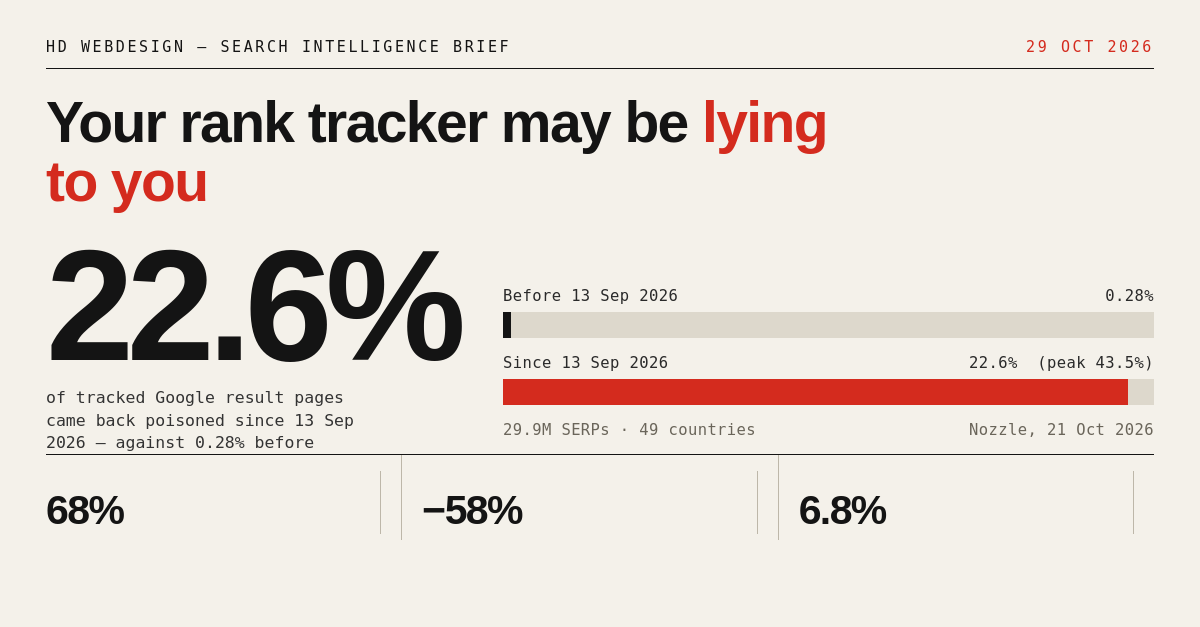
Nozzle analysed 29.9 million SERPs across 49 countries, with data through 21 October 2026. Since 13 September, 22.6% of the SERPs it judged on page 1 or page 2 came back poisoned, against 0.28% before. The peak was 43.5% on 30 September. The rate eased to 4–6% in mid-October, then climbed back to 35.7% on 21 October. Requests to Google started failing on 13 September; from 20 September onward, the requests that got through returned altered pages.
The mechanics matter more than the headline percentage:
- Only 22.3% of the previous day's sites survive on a poisoned page, against 88.1% normally. Social platforms and forums take their place.
- A tracked project's own site is missing from the top 10 on 60.8% of poisoned SERPs, against 2.7% normally. That is what a ranking crash looks like from the inside.
- 67.9% of poisoned rankings have their usual sites back within three days.
- Page 2 is poisoned 1.5× as often as page 1, mostly underneath a page 1 that looks fine.
AccuRanker published its own measurements on 19 October 2026, updated since. On its worst day, 24 October, Google poisoned 40% of its first desktop fetches. After AccuRanker's checks, 3.2% of desktop keywords in its sample still showed a swapped page 1, and the figure was back under 1% the next day. Google's own steps continue: it tightened detection on 15, 20 and 23 October, and after the 23 October step it still poisons 4–6.5% of first fetches, against 1.6–3.3% in the days before. Whole-page flips of this kind were rare in 2025, roughly 1 in 1,000 daily checks or fewer.
DemandSphere reported wrong results on about 11% of its daily rank checks on 7 October 2026. And Search Engine Watch's round-up of the trackers, published 19 October 2026, quotes Semrush's line that most individual cases show up beyond the first page, which is exactly the range clients rarely look at and reports still count.
Why Google is doing it
Google has said nothing. The explanation every tracker lands on is the same: this is collateral damage from Google's fight against bulk scraping for AI answer engines, with rank trackers caught in the middle. Rank trackers request the same query across millions of keyword, location and device combinations. That pattern now looks to Google like data collection rather than searching.
It did not start in September. AccuRanker's stored rankings show smaller rounds of the same behaviour from late January 2026, switching on and off by weekday and hitting local searches first. From April to July those rounds ran at 7 to 10 times their 2025 level. 24 September was the big step, not the first one. Google also appears to decide per browser session rather than per keyword, which is why the poisoning follows how a tool collects data instead of what you happen to track.
There is a useful irony here. The industry spent September and October arguing about whether the AI scraping war is hurting the open web, and it turned out to be hurting the measurement layer first. We ran into the same tracker-versus-reality gap after Google's September spam update, when trackers showed movement searchers never saw.
The clicks were already going, and that is the bigger number
Poisoned SERPs corrupt what you see. The click decline changes what is there to see.
SparkToro, using Similarweb clickstream data, found that 68.01% of US Google searches ended without a click in the first four months of 2026. The same series reads 60.45% in 2024, 49% in 2019 and around 45% a decade ago. Zero-click predates AI Overviews, so AI is an accelerant rather than the cause, but the acceleration is real.
Where an AI Overview appears, the loss is measurable. Ahrefs, analysing 300,000 keywords of Search Console data, found AI Overviews correlate with a 58% drop in click-through for the number one organic result, nearly double its own April 2025 figure. Pew Research measured the same effect behaviourally in March 2025: with an AI Overview present, 8% of sessions clicked a traditional result, against 15% without one. A randomised field experiment with about 1,100 Google users, published in August 2026, assigned participants to AI Mode and measured an 18.8 percentage point drop in click-through to external sites. The Reuters Institute's Digital News Report 2026, covering 27 markets, found only 4% of people always or often click through from an AI chatbot answer, against 19% from a search engine.
Before anyone writes search off, the counter-numbers deserve saying. In June 2026 search engines delivered 162.19 billion monthly visits against 8.26 billion for all AI chatbots combined, roughly 19.6 times more. 95% of ChatGPT users also use Google. And referral traffic is recovering where engines change behaviour: ChatGPT's 7 May 2026 search update roughly doubled its US desktop referral landing rate, from 25% in March to about 60% by 30 May. Search is not dying. It is handing out fewer clicks per query.
Citations are the new currency, but they are not cash yet
The obvious strategic response is to stop chasing clicks and start chasing citations. That direction is right, and the maturity of the claim matters. If the terminology is new, SEO, GEO and AIO describe three different jobs, and this article is about the data you use to judge all three.
AI responses containing citations rose more than fivefold in a year, according to Similarweb, published July 2026. But only 6.8% of US ChatGPT desktop queries included citations in May 2026. The cited surface is still small. It also behaves unlike ranking: of the URLs Google's AI Overviews cite, 37.1% also rank in the organic top 10, while 36.7% do not rank in the top 100 at all, based on Ahrefs' analysis of 4 million AI Overview URLs. Classic rank tracking was never built to see the second group.
What gets cited is a known pattern. In Peec AI's dataset of 7,387 B2B buyer-prompt citations, published September 2026, product pages took 24.1%, articles 17.4%, comparisons about 13%, listicles about 13%, and homepages 7.8%. Comparison prompts were 20% of prompts but 27% of citations, a 1.33× return. Across 3,850 commercial supplier-selection prompts, directories supplied 41% of citations, twice the rate of brand pages.
And cited is not clicked. 65% of ChatGPT-cited URLs sit two or three folders deep, while 58.8% of AI referral traffic lands on the homepage. The page that earns the citation and the page that earns the visit are usually different pages. No study yet shows citation share converting into revenue, and tools count mentions and citations differently, so numbers from two vendors will not match. Treat citation share as a visibility metric with a growing industry behind it, not as a bank balance.
What to measure instead
- Search Console before you react. The compromised channel is now the third-party tracker, not Google's own reporting. A drop that is real shows up in impressions and clicks there, over several days.
- Give rankings three days. 67.9% of poisoned rankings revert within three days, and whole-page flips were about 1 in 1,000 daily checks in 2025. A one-day collapse that bounces back was probably never a change.
- Keep two KPI families separate. Citation and visibility share per AI model on one side, referral landings and downstream conversions on the other. Merging them produces a number neither team can act on.
- Build pages that are built to be quoted. Self-contained two to four sentence answers under clear headings, statistics with a named source, and first-hand experience. Google itself says experience matters more than any other of its content suggestions.
- Publish comparison and product pages, and claim your directory profiles. Comparisons over-perform at 1.33×, and directories supply 41% of commercial citations.
- Do not abandon SEO. 37% of AI Overview citations still come from top-10 rankings, local queries show only 7.9% AI Overview presence, and search still delivers 19.6× the traffic of every AI chatbot combined.
- Track revenue, not position. A page can gain visibility while the queries that pay lose clicks.
What this means if you run a small business
Nothing about this week requires a new tool subscription. Two habits cover most of it. First, when a dashboard shows a catastrophe, confirm it in Google Search Console before you change anything on your site. The trackers just spent six weeks receiving data Google was quietly scrambling, and a panicked redesign driven by poisoned data is worse than doing nothing. Second, ask what your business looks like when someone asks ChatGPT or Gemini instead of searching. That is not a ranking you can check in a rank tracker, because most of those citations do not come from pages that rank anywhere near the top. It takes about five seconds to get an A–F answer.
See how AI tools describe your business
Free AI Visibility Card: enter your URL and get an A–F score of how ChatGPT, Gemini and Perplexity see your company, in about five seconds.
Get your free AI score →Frequently asked questions
What is a poisoned SERP?
A poisoned SERP is a Google results page returned to an automated tool that looks complete and normal, but whose organic listings have been swapped for a different set of sites. There is no error and no CAPTCHA, so rank trackers record it as real data. Nozzle measured 22.6% of 29.9 million tracked SERPs as poisoned between 13 September and 21 October 2026, against 0.28% before, with a peak of 43.5% on 30 September.
Did Semrush confirm that Google is feeding SEO tools bad data?
Yes. On 27 October 2026 Semrush published a statement saying it has seen Google return inaccurate results to automated collectors since late summer, called it an industry-wide issue affecting data providers across the SEO space, and said the likely driver is Google's effort to limit large-scale data collection for AI systems. Semrush said the impact on tracked rankings has been limited and mostly appears beyond page one. Google has not commented.
How do I tell a poisoned ranking from a real ranking drop?
Check Google Search Console. A real drop shows up there as falling impressions and clicks across several days. A change that appears only in a third-party rank tracker, affects many unrelated keywords at once, and recovers within three days is almost certainly a poisoned result: 67.9% of poisoned rankings return their usual sites within three days, according to Nozzle's data through 21 October 2026.
Are SEO rank trackers reliable in 2026?
They are recovering, not finished. Semrush added validation checks and re-collection; AccuRanker reported that after its own filtering, 3.2% of sampled desktop keywords still showed a swapped first page on 24 October 2026, falling to 0.6% by 25 October. The safest use of rank data now is directional and multi-day, cross-checked against Search Console, rather than day-to-day.
Should I optimise for AI citations instead of rankings?
Do both. Search still delivers about 19.6 times the monthly visits of all AI chatbots combined (162.19 billion against 8.26 billion in June 2026), and 37.1% of AI Overview citations come from pages already in the top 10. At the same time, 36.7% of cited URLs do not rank in the top 100, so ranking alone no longer guarantees being cited. Track citation share and referral conversions as separate metrics.
Sources: Semrush, "Poisoned SERPs: An update on Google ranking data in Semrush," 27 October 2026; Search Engine Land, 27 October 2026; Nozzle research, data through 21 October 2026; AccuRanker, 19 October 2026, updated; Search Engine Watch, 19 October 2026; PPC Land and DemandSphere, 7 October 2026; SparkToro with Similarweb clickstream, 8 June 2026; Ahrefs, 300,000 keywords of Search Console data, published February 2026; Pew Research Center, March 2025; Reuters Institute Digital News Report 2026; Peec AI via Search Engine Journal, September 2026; Similarweb, July 2026.